



BrowserStack vs. Global App Testing
BrowserStack gives your team devices to run tests on. Global App Testing gives you a fully managed team of real people who run complex, real-world flows for you in the markets you're launching in.
Global App Testing vs BrowserStack vs others
Which business is better for your organization is likely to depend on your specific requirements. Set up a meeting with Global App Testing now and we can help you think about your provider.
- See Global App Testing vs BrowserStack
- Discuss other leading suppliers
- Understand which supplier is the right fit
- Talk in detail about your requirements
Trusted by:


Why do product teams choose Global App Testing over BrowserStack?
190+ countries
Test with real people who use their own cards, SIMs and IDs where your customers live.
Fully managed
Brief us once, our team sets up the cycle, vetted testers run it, and results come back in hours.
We work with some of the largest technology companies in the world, including Meta, Apple and OpenAI. We built our service for enterprise teams that need real people in real markets to complete payment, identity, language and regulated flows before a release, with our team scoping, setting up and managing each engagement.
What sets Global App Testing apart
Run real local payments before you launch
Payment failures in a new market usually come from the parts a sandbox can't reproduce, such as a bank's 3DS challenge, a local method like Boleto or PIX, or a refund that has to land back on the original card. Our testers run those flows with their own cards and accounts. BrowserStack supports Apple Pay and Google Pay on real devices, but its Apple Pay testing uses sandboxed cards, one card per session, in a private beta on Team Pro and Enterprise Pro plans.
- 3DS and SCA challenge flows completed by real cardholders, from card entry through settlement, refunds and order confirmation
- Wallets and app-based methods including PayPal, Apple Pay, Google Pay, Klarna and Revolut, plus local methods such as iDEAL, Boleto and PIX
- Coverage across 10+ card networks, 100+ virtual card types, 300+ card issuers and bank transfers across 300+ banks
Test SMS, OTP and carriers where your users live
An OTP that arrives late, or never reaches a local carrier, can block a signup, login or payment before anything else gets tested. Our testers carry their own SIMs and data plans in 190+ countries, so the message travels the real carrier path. BrowserStack offers SIM-enabled devices in four countries (Australia, Ireland, India and the USA) for SMS only, and IP geolocation in 60+ countries while the device itself stays in a BrowserStack data center.
- Testers on their own local SIMs, carriers and data plans
- 190+ countries and territories
- Access attempts from restricted regions, tested from inside the region
Complete identity, KYC and localization with real people
Regulators and customers judge identity checks and localized screens differently in each country, which is why real documents and native-language judgment matter. Our testers complete KYC and liveness flows with real documents and review your product in 160+ languages. BrowserStack's closest tools are image injection (up to five images per session), simulated pass or fail biometrics, and a device locale switch.
- Passports from 190+ issuing countries, national ID cards such as Aadhaar, DNI and MyKad, driver's licenses, utility bills and bank statements
- Facial scans, live selfies and liveness checks
- Native-speaker review in 160+ languages against a nine-point localization checklist
Hand us the cycle and get results in hours
You brief us, our team designs and sets up the scenarios, vetted testers run them, and results come back in about 6 hours for a functional run and within 48 hours for localization. With BrowserStack, your own team writes, runs and maintains the tests.
- About 6 hours for a functional run, within 48 hours for localization
- 48-hour average for a full payment gateway test
- Test design, setup and triage handled by our team
BrowserStack vs. Global App Testing: side-by-side comparison
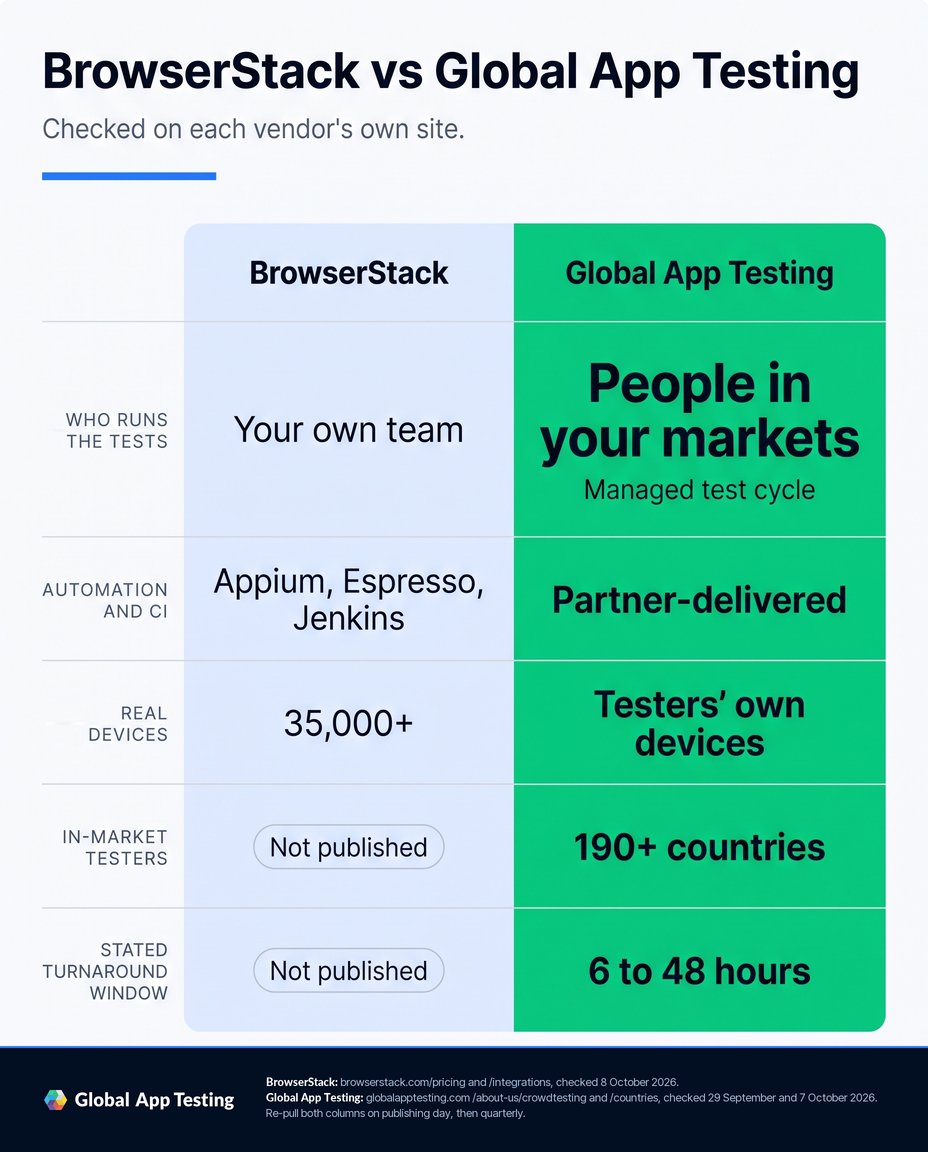
Here's how the two compare on the criteria buyers weigh when they're deciding between a device cloud and managed crowdtesting.
| Criteria | Global App Testing | BrowserStack |
|---|---|---|
| Who writes and runs the tests | Our team designs and sets up the cycle; vetted testers run it after you brief us | Your team writes, runs and maintains the tests |
| Tester network | 120,000 professional testers and 1 million profiles across 190+ countries | No human testers or managed testing service |
| Countries | 190+ countries and territories, with testers on the ground | IP geolocation in 60+ countries and 30+ states; SIM-enabled devices in 4 countries; Apple Pay in 16 geographies |
| Payment methods | Real cards across 10+ card networks, 100+ virtual card types and 300+ card issuers; wallets including PayPal, Apple Pay, Google Pay and Samsung Pay; Klarna, Revolut and other app-based methods; bank transfers across 300+ banks; crypto; local methods such as iDEAL, Boleto and PIX | Apple Pay (sandboxed cards, one per session, private beta on Team Pro and Enterprise Pro) and Google Pay on real devices |
| Identity and KYC testing | Named service: passports from 190+ issuing countries, national ID cards (Aadhaar, DNI, MyKad), driver's licenses, residency permits, utility bills, bank statements, facial scans, live selfies, liveness checks | Image injection of your own files, up to five per session; biometrics simulated |
| SMS, OTP and carriers | Testers' own SIMs and carriers in 190+ countries | SMS only on SIM-enabled devices in Australia, Ireland, India and the USA; no calls or mobile data; Team Pro and Enterprise Pro |
| Languages | 160+ languages, native speakers | Device locale switch; no human language review |
Key insight: A device cloud tells you whether your app works on a device. Whether a real customer in Brazil can pay with Boleto, receive an OTP on a local carrier and pass ID verification is a different question, and it takes people in that market to answer it.
When Global App Testing is the better fit
Global App Testing is the better fit when the risk in your release sits with real people in real markets:
- Payments, refunds and 3DS challenges have to work with real cards and local methods
- OTPs and SMS have to arrive on local carriers
- KYC, liveness and age checks need real documents and real faces
- Screens need native-speaker review in 160+ languages
- You want a team to design and run the testing, with no scripts for your engineers to maintain
When BrowserStack may be the better fit
BrowserStack is the better fit when you need automated regression in CI at scale, parallel sessions on every pull request, or visual testing with Percy. The two also work well side by side, with BrowserStack running your automation and Global App Testing covering in-market testing before a launch.
Frequently asked questions: BrowserStack vs. Global App Testing
Is Global App Testing an alternative to BrowserStack?
Yes, when what you're missing is real-world human testing. Global App Testing is a managed crowdtesting service with 120,000 professional testers in 190+ countries, while BrowserStack is a self-serve device and browser cloud that your own team runs tests on. If you need automation infrastructure, BrowserStack is the right comparison set; if you need people in your launch markets, we are.
Does BrowserStack provide human testers?
No. BrowserStack doesn't offer human testers, crowdtesting or a managed testing service. What it calls manual testing is your own team driving a remote device through its Live or App Live products. Our testers run the scenarios for you and send back results in hours.
Can BrowserStack test real payments?
Within documented limits. BrowserStack supports Apple Pay and Google Pay on real devices, with Apple Pay running on sandboxed cards, one card per session, in a private beta on Team Pro and Enterprise Pro plans. Local methods such as iDEAL, Boleto and PIX aren't covered. Our testers run those methods with real accounts and cards, including 3DS/SCA, refunds and settlement.
Do I need to write test scripts to use Global App Testing?
No. You brief us on the flows, markets and devices that matter, our team designs the test cases and sets up the cycle, and our testers run it. Results come back in about 6 hours for a functional run, so your engineers can stay on your automation suite.
Can I use BrowserStack and Global App Testing together?
Yes. A common setup runs BrowserStack for automated regression and parallel CI sessions, then brings in Global App Testing before a launch for real-world payments, identity, localization and regulated flows in the target markets. Both integrate with Jira and GitHub, so our bug reports can land in the same backlog as your automated results.
How fast does Global App Testing return results?
A functional run comes back in about 6 hours, localization within 48 hours, and a full payment gateway test averages 48 hours. BrowserStack sessions are on demand, so the timing there depends on when your team writes and runs the tests.
Is Global App Testing ISO 27001 certified?
Yes. Global App Testing is ISO 27001 certified, testers sign NDAs, and you can restrict access by VPN, IP or email domain.
What are the other BrowserStack alternatives?
The main device cloud and browser testing alternatives are Sauce Labs, TestMu AI (formerly LambdaTest), AWS Device Farm and Firebase Test Lab. If what you need is managed human testing in real markets, Global App Testing is the one to compare. Our full list of BrowserStack alternatives is on the blog.
Ready to test where your customers are?
Tell us your launch markets, payment methods and devices, and we'll scope a quote around your release plan. In a demo, we'll walk you through how our testers would run those flows in your launch countries.