





AI is reshaping software testing by changing how teams design tests, automate execution, and maintain quality at scale. As modern software grows more complex and release cycles accelerate, traditional approaches struggle to keep up. AI in software testing provides new ways to improve test coverage, reduce test maintenance, and deliver reliable software faster.
This article explains what AI is, how AI in software testing works, which AI testing tools are commonly used, and what the future of software testing looks like. It is written to answer common questions clearly and practically, making it useful for both decision makers and technical teams.
What is AI, and why does it matter in software testing?
Definition of AI
AI, or artificial intelligence, refers to systems that can analyse data, recognise patterns, and make decisions with limited human intervention. In software testing, AI enables systems to learn from test results, application behaviour, and historical data to improve testing outcomes.
Relevance to software testing
AI matters because software testing is no longer static. Applications change frequently, and testing must adapt just as quickly. AI in software testing refers to using artificial intelligence to support testing tasks, such as test case selection, generation, and maintenance.
By applying AI, teams can identify risk areas earlier, prioritise testing more effectively, and improve software quality across the software development life cycle.
How is AI used in software testing?
AI is used in software testing to automate repetitive tasks, analyse large volumes of test data, and support better decision-making. Instead of executing every test equally, AI evaluates risk and impact to guide testing efforts.
Common ways teams use AI in software testing include analysing test results, improving test coverage, and optimising test execution. AI helps teams focus on high-value testing activities while reducing time spent on low-risk areas.
This makes the testing process more efficient and better aligned with modern software development.
How does AI testing fit into modern software testing?
AI testing fits into modern software testing by enhancing, not replacing, existing practices. Teams still rely on manual testing, unit testing, and regression testing, but AI adds intelligence on top of these methods.
AI enhances modern software testing by:
- Supporting manual testing with data-driven insights
- Prioritising unit testing based on code changes
- Optimising regression testing using risk analysis
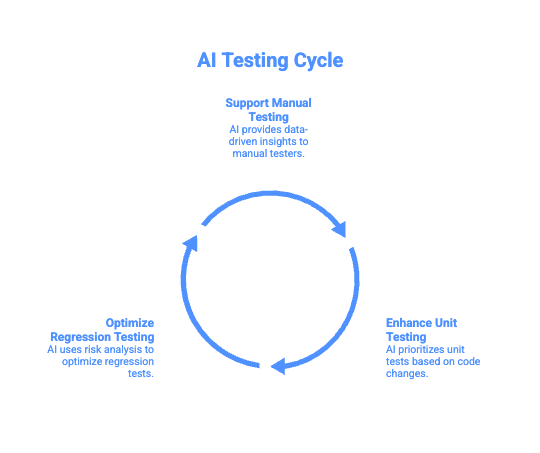 This approach supports continuous testing and helps teams deliver reliable software at speed.
How does AI improve test automation?
Test automation is essential in software testing, but traditional automation is fragile. Scripts break when applications change, increasing test maintenance effort. AI improves test automation by making automated tests adaptive.
AI-driven automation uses an AI model to understand application behaviour. When changes occur, self-healing AI can automatically update test scripts. This allows teams to automate tests more effectively and reduce ongoing maintenance.
As a result, AI-driven testing improves test coverage, stability, and efficiency across large test suites.
What testing tools and AI testing tools are commonly used?
AI testing tools generally fall into three functional categories.
Test generation tools
These tools generate test cases and test scripts based on requirements, usage data, or code analysis.
Test execution tools
These tools automate tests and optimise execution by selecting the most relevant test cases first.
Test analysis tools
These tools analyse test results, detect anomalies, and identify patterns across large volumes of testing data.
Selecting the right testing tool depends on the software testing process, existing test suites, and testing goals.
What role does generative AI play in software testing?
Generative AI plays an important role in AI software testing by accelerating test creation and test data preparation.
Generative AI is commonly used for:
- Generating test scenarios from requirements
- Creating test scripts for automation
- Producing edge cases that are difficult to anticipate
By supporting exploratory testing and expanding test coverage, generative AI helps teams uncover issues earlier and improve test efficiency.
 How does AI improve test case generation and test data?
Test case generation is one of the most impactful uses of AI in software testing. AI can analyse requirements, code changes, and historical defects to automatically generate test cases.
AI also improves test data generation by creating realistic datasets that mirror production conditions. This is especially useful for performance testing, API test scenarios, and UI testing where data accuracy is critical.
Using AI to generate test cases and test data improves coverage while reducing manual effort.
What types of testing benefit most from AI?
AI supports many testing types across the software testing process.
- Regression testing, where AI prioritises tests based on risk
- Visual testing, where AI detects UI changes across versions
- Performance testing, where AI analyses trends in test results
- Exploratory testing, where AI highlights unusual behaviour
AI-powered testing tools help teams apply the right testing approach without unnecessary duplication.
Can AI replace human software testers?
AI cannot completely replace human software testers. While AI can automate tests, analyse test results, and optimise test coverage, it lacks human intuition and contextual understanding.
Manual testing remains essential for usability testing, exploratory testing, and validating business logic. Human testers are also needed to design effective test strategies and interpret complex results.
The most effective approach combines AI and human expertise, allowing teams to scale testing while maintaining quality.
What are the benefits of AI in software testing?
The benefits of AI in software testing span both technical and operational areas.
Key benefits include:
- Automates complex testing tasks
- Improves test coverage and accuracy
- Reduces test maintenance effort
- Speeds up feedback across the testing process
These AI benefits in software testing help teams deliver reliable software without slowing development.
What are the challenges and limitations of AI in software testing?
Despite its advantages, AI in software testing has limitations. AI models depend heavily on high-quality test data, and poor data can lead to inaccurate results.
Another challenge is transparency. Some AI powered testing tools act as black boxes, making it difficult to understand why certain test cases are prioritised. Teams must validate AI-driven decisions carefully.
AI also does not eliminate the need for manual testing. The best results come from combining AI-assisted automation with experienced testers.
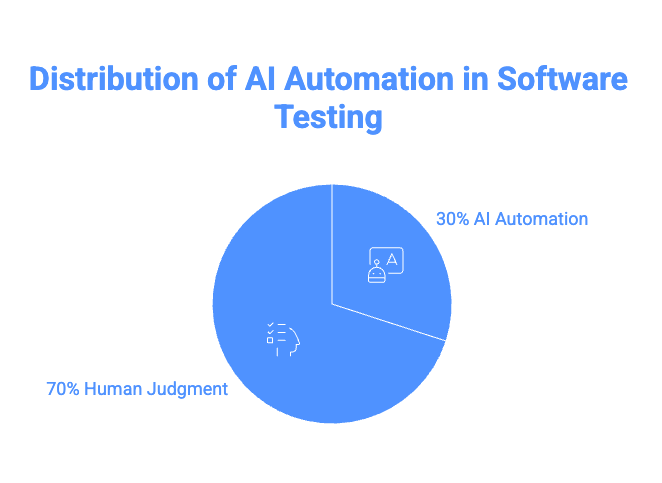
What is the 30% rule in AI for software testing?
The 30% rule in AI for software testing is an informal guideline suggesting that AI can automate or optimise around 30% of testing tasks without heavy customisation.
This typically includes:
- Test case generation
- Regression test selection
- Test maintenance
The remaining testing work benefits from human judgment. Understanding this rule helps teams set realistic expectations when adopting AI.
How is AI shaping the future of software testing?
AI is shaping the future of software testing by making testing more predictive and adaptive. AI agents and agentic AI will increasingly support decision-making across testing workflows.
AI-driven automation will replace traditional automation that relies on static scripts. AI and machine learning will support smarter testing systems that adapt in real time.
In the future of software testing, teams will work with AI to deliver higher-quality software faster and more reliably.
Key things to remember
- AI improves software testing by making it adaptive and data-driven
- AI in software testing enhances test automation and coverage
- Generative AI accelerates test creation and test data generation
- AI does not replace testers but supports better decision-making
The future of software testing relies on AI-driven testing systems