





Imagine a QA report showing 100% pass rate for the checkout feature, but the location drop-down is missing crucial user locations. Users report the bug only after the application goes into production. This is not an issue with the automation script, but QA coverage in real-world testing, and ultimately a gap in AI testing accuracy.
These gaps arise because teams rely on limited datasets and predictable inputs. Scripted flows and strong metrics often miss issues caused by real user behavior and regional data. In real-world AI testing, AI helps close this gap by expanding coverage with realistic inputs and edge cases, making test results more reliable for release decisions.
In this blog, we explore how testing tools and techniques can improve accuracy and help close gaps in real-world testing.
Defining real-world testing accuracy
Real-world testing evaluates software from the user’s perspective, revealing device, network, and usage issues that scripted tests miss. This approach enables teams to identify real use cases, user behaviors, edge cases, and environmental factors that may not surface during manual or automated testing.
For example, Booking.com partnered with Global app testing QA teams to bring real-world accuracy across priority regions for critical user journeys.
Let’s look at the key differences between traditional and real-world testing:
|
Aspect |
Traditional testing |
Real-world testing accuracy |
|
User behavior |
Assumes predictable, linear journeys |
Reflects how users actually interact with the product |
|
Test coverage |
Limited to selected devices and environments |
Covers real devices, networks, and regions |
|
Bug Prioritization |
Based on test cases and pass/fail status |
Based on impact, risk, and usage |
|
Release confidence |
Coverage-driven |
Decision and UX driven |
The limitations of traditional testing require teams to go beyond scripted checks and evaluate results by real-world impact.
Limitations of traditional testing approaches
Traditional testing approaches, such as exploratory and end-to-end testing, validate user flows but often miss network delays, invalid inputs, and device-specific quirks. As a result, an application can pass all traditional tests while still delivering a poor or unreliable user experience.
In addition to these, below are the key limitations of traditional testing approaches:
- Predictable scripts vs. real behavior: Tests follow defined paths, while real users take varied and unpredictable journeys.
- Limited coverage: Many device, network, and regional combinations never get exercised in controlled test setups.
- Past failures are underused: Teams rarely apply historical issues systematically to improve future test focus.
- High coverage, low confidence: Executing more tests doesn’t necessarily translate into confidence at release time.
At Global App Testing, teams close these gaps by prioritizing real-world risk and usage.
- Analyze real-world patterns: Review test results across devices, networks, and regions to pinpoint recurring failures that impact users.
- Prioritize high-risk flows: Identify and validate functionality that users rely on most, including edge cases that could block key tasks.
- Adapt coverage continuously: Update tests as user behavior changes, using generated inputs to simulate real-world scenarios and uncover hidden issues.
Shifting focus from routine checklists to an AI-based approach allows teams to catch key issues ahead of release, building confidence in software quality and user experience.
How AI improves accuracy in real-world testing
In quality assurance, artificial intelligence techniques and tools can help with test case documentation, test coverage across multiple user inputs, and detailed analysis of QA reports. When applied correctly, these capabilities significantly improve AI testing accuracy by aligning test results with real user behavior and risk.
Our teams use the following AI testing techniques to improve testing accuracy:
Learning from large-scale test data
AI tools learn from and are trained on historical data. Analyzing test results, user behavior, and past failures uncovers patterns traditional tests miss, improving testing accuracy.
This allows teams to adopt a more targeted testing strategy that improves decision-making, reduces uncertainty before release, identifies error-prone areas, and prevents recurrent issues.
Risk-based test focus
Insights from past failures and unusual usage guide testing toward high-risk areas, aligning coverage with real user behavior.
This helps teams to adjust test coverage based on past defects and usage trends, and identify edge cases that scripted tests often overlook.
Adaptive validation of user behavior
Adaptive validation means updating test cases as the application expands into global regions. As products evolve and usage shifts, new issues appear outside predefined test paths. Adaptive validation ensures teams stay in sync with these changes and catch issues early.
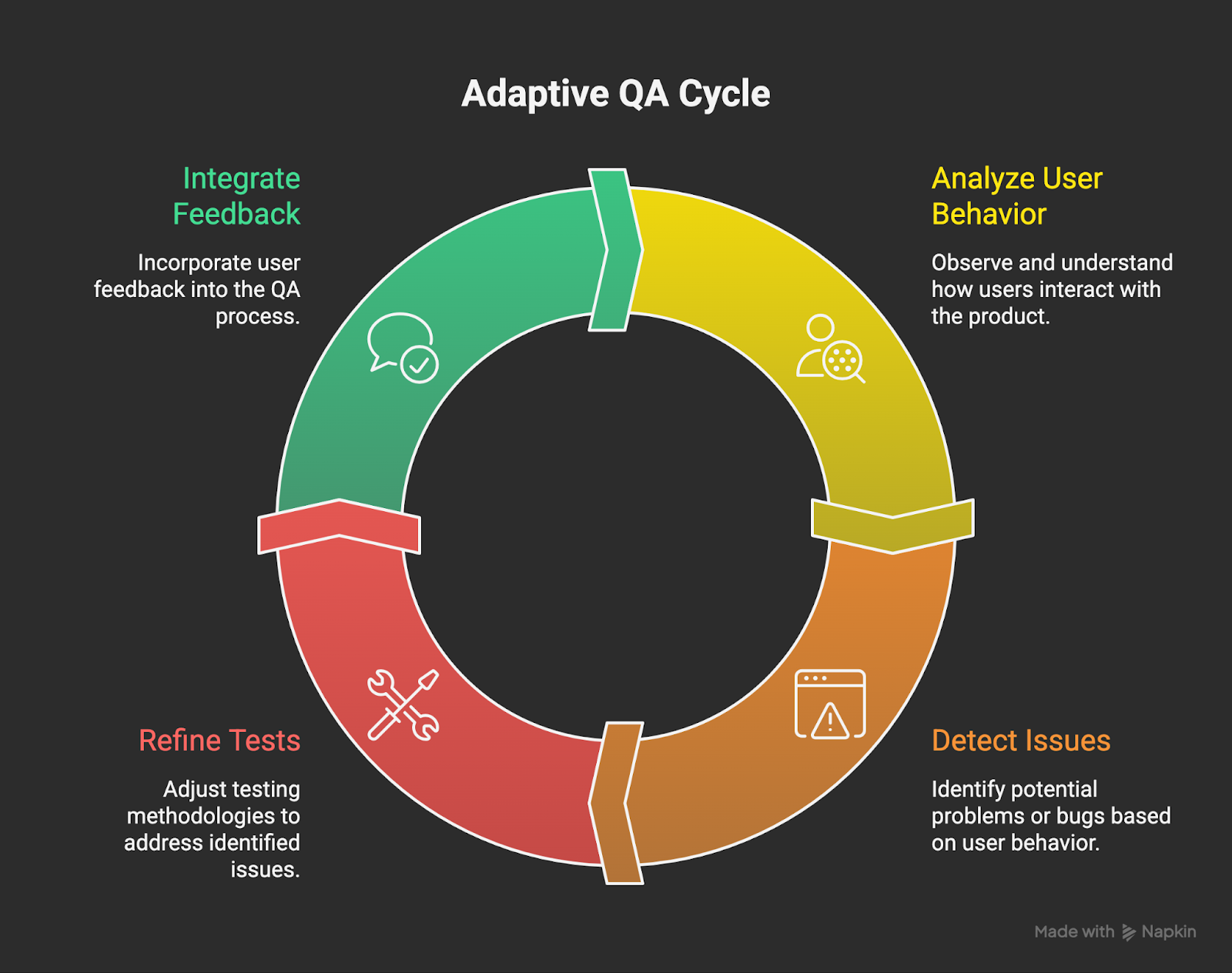
Adaptive testing workflow
In practice, this enables teams to spot language or localization issues across regions, detect device-specific issues, and identify accessibility gaps.
In one engagement, GAT uncovered accessibility barriers that affected navigation for assistive technology users, enabling the client to address usability blockers ahead of launch.
Real-world edge cases AI helps surface.
Some of the most disruptive issues never appear during controlled testing. For example, if testing is done for Apple and Samsung devices, the UI might break for users in China using Xiaomi devices.
These issues appear only when users interact with products across regions, devices, and real network conditions.
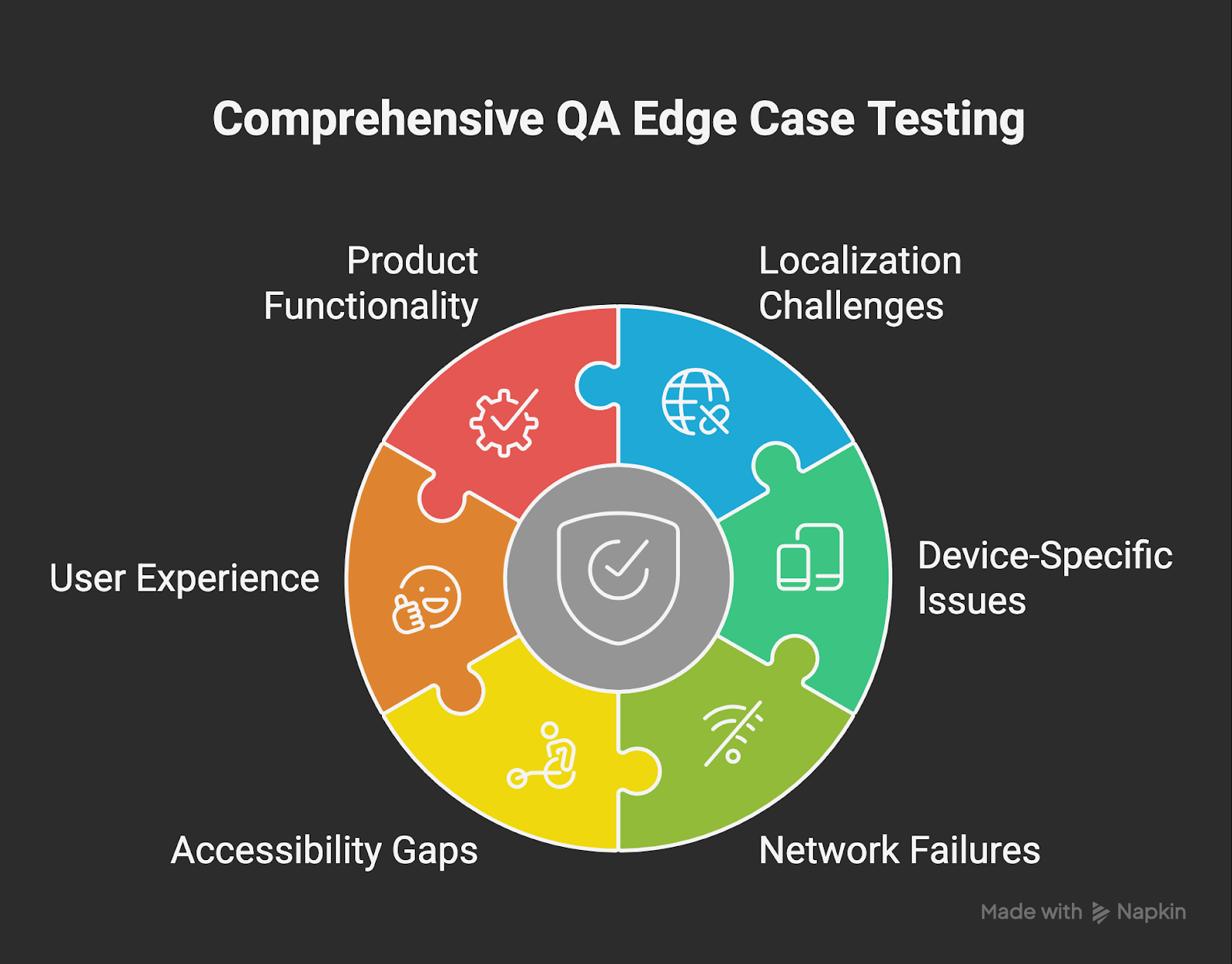
Real-world testing edge cases
QA at global app testing uses AI to uncover such corner cases for testing accuracy:
- Localization and language inconsistencies: Applitools AI features help identify text truncation, misaligned layouts, or unclear translations.
- Device-specific UI and performance issues: Tools such as Browserstack help with visual breaks, input problems, or slow interactions tied to particular devices or OS versions
- Network-related failures: Fiddler or Charles proxy is used to identify errors caused by latency, dropped connections, or limited bandwidth.
- Accessibility gaps: AxeDevtools enables automated accessibility testing scans for the applications.
The role of human validation in accurate testing
AI testing does not replace human or manual testing. Enterprises still need a good QA team to:
- Assess user experience for clarity and usability
- Determine which journeys require automation
- Evaluate defect severity in real usage
From a Global App Testing standpoint, accuracy comes from combining signal with judgment. Human validation determines which issues require action, while automated tools support focus and efficiency.
Scaling accuracy with AI and real users
Global launches of enterprise applications bring large-scale traffic and heavy user activity. This requires in-depth performance testing, localization testing for each region, UX testing for a specific user base, and automated regression testing to accelerate release cycles.
Our QA teams use the following AI testing techniques when testing on scale:
- Leverage tools like GitHub Copilot as coding assistants, helping with test case generation.
- Integrate AI tools to help write self-healing test cases.
- Recognize patterns and recurring risks across devices, regions, and scenarios using AI-driven reporting.
- Prioritize fixes that improve the user experience and reduce post-release issues by leveraging Jira and qTest's AI features.
Global App Testing helped Flip run large-scale real-user tests with structured reviews, uncovering blockers early, shortening regression cycles, and providing a clear view of release readiness.
By observing real users and reviewing results in context, GAT ensures tests reflect actual usage, enabling confident release decisions.
Measuring the impact of AI on testing accuracy
Engineering VPs measure accuracy by how well testing supports confident, timely releases, not bug counts. AI testing helps measure release readiness by analyzing risk signals, coverage intelligence, failure patterns, and production predictability, all of which contribute directly to stronger AI testing accuracy.
To assess true accuracy, teams need more than defect counts. Here are some key indicators that engineering teams should track:
|
Indicator |
What it shows |
Why it matters |
|
False positive rate with AI defect logging |
How many reported issues are not real problems |
Reduces wasted engineering effort |
|
Defect relevance |
Whether issues impact users or business goals |
Improves prioritization and focus |
|
Time to identify critical risks after AI tools integration in the QA cycle |
How quickly are release-blocking issues found with AI testing |
Prevents late-stage surprises |
|
Real-world test coverage |
How many user journeys and corner cases have AI tools identified |
Measures how much real-world testing is covered |
|
Release readiness confidence |
Team trust in test metrics shown in AI insights and reports |
Enables faster, safer releases |
By tracking these indicators, engineering leaders can keep testing aligned with real-world usage, cut through noise, and make confident decisions about when software is ready to ship.
Best practices for improving real-world testing accuracy with AI
The success of engineering teams is measured not by how many bugs they find, but by how confidently and consistently they develop features. By applying AI testing best practices such as intelligent risk analysis, smarter test selection, and signal optimization, teams can significantly improve real-world testing accuracy and ensure that what passes in pre-production holds up in production.
Below are a few best practices that QA teams at global app testing follow to ensure real-world accuracy with AI testing:
- Letting insights guide testing: Use AI tools to analyze historical failures, usage patterns, and user behavior to determine where testing is needed and where it is least needed.
- Validating with actual users: Humans verify whether AI-detected issues affect the user interface and whether they are of actual concern to the business.
- Authentic test environments: Replicate real environments in testing to identify risks that don’t appear in scripted checks.
- Continuously evaluating relevance: Re-evaluated the test cases consistently as the application grows, using AI test coverage tools.
As teams develop this into a habitual process, test accessibility is maintained, risk exposure decreases, and confidence in user interaction with the software increases.
Key takeaways: Accuracy comes from context
In real conditions, AI testing accuracy depends on context, not test volume. Data highlights patterns, but human judgment determines what truly matters for release.
Data and automation help highlight patterns, but human testers determine what truly matters. By validating impact, reassessing relevance, and adapting to changing usage, teams make confident, informed release decisions.
Explore how Global App Testing helps teams validate software on real devices, across networks and regions.