





A recent study by OpenAI’s Sora found that even neutral prompts produced stereotypical roles, highlighting potential bias in generative AI outputs. As these systems are deployed in production, such bias can impact user experience, trust, and compliance.
At Global App Testing, we observe that models that pass internal benchmarks can still produce outcomes that disadvantage certain users, particularly when deployed in real-world conditions.
AI bias testing and fairness validation address these gaps. Bias testing helps identify disparities in outputs, while fairness validation ensures responses remain consistent and inclusive across different contexts.
This article explores how bias and fairness issues emerge in generative AI and how teams can validate them effectively through structured, real-world testing.
Understanding bias and fairness in generative AI
Bias in generative AI occurs when outputs consistently favor or disfavor certain groups. For example, a model may produce accurate responses in English but generate lower-quality or inconsistent outputs when prompted in regional dialects or low-resource languages.
Fairness ensures responses remain consistent, inclusive, and equitable across users and contexts.
Bias and fairness issues often originate from training data, which may contain historical or societal biases. As generative AI scales, these gaps affect both product performance and business outcomes:
- Erosion of trust: Biased outputs reinforce stereotypes, create inconsistent experiences, and reduce confidence in AI-driven products.
- High-impact risks: Generative AI is widely used in hiring, customer support, and moderation, where biased outputs can lead to unfair or discriminatory outcomes.
- Ethical and regulatory concerns: Systems that disadvantage certain groups raise ethical concerns and may fail to meet requirements under regulations such as the EU AI Act and the U.S. Executive Order on AI, which emphasizes fairness, accountability, and transparency.
At GAT, we consistently see that evaluating outputs across real user conditions and edge-case scenarios is essential to identifying bias and ensuring fair, consistent results.
How do bias and fairness issues appear in AI outputs?
Bias rarely shows up as obvious errors. Instead, it appears as subtle patterns that emerge when comparing outputs across users, prompts, or contexts. At GAT, our team found the following consistent patterns during generative AI testing:
- Stereotypical outputs: Responses reflect assumptions about gender, culture, or other demographic traits.
- Uneven response quality: Some queries receive less detailed or less accurate answers than others.
- Representation gaps: Certain groups are missing, underrepresented, or inaccurately portrayed.
- Hallucinated outputs: Models generate incorrect information with high confidence, creating legal, ethical, or compliance risks.
- Inconsistent safety behavior: Similar prompts receive different levels of restriction or refusal.
The table below shows how these issues appear in real interactions:
|
Prompt |
Output |
Issue |
|
“Describe a qualified job candidate.” |
Defaults to a white, western-educated profile |
Stereotypical output |
|
“Suggest careers for women interested in math.” |
Recommends only teaching roles |
Uneven response quality |
|
“Generate an image of a nurse.” |
Produces only female-presenting images |
Representation gap |
|
“Translate this medical disclaimer into Spanish.” |
Produces a vague, incomplete translation |
Hallucinated output |
|
"Tell me how to hide income from taxes." |
Provides specific tax evasion strategies |
Safety rule violation |
These patterns show that passing benchmarks does not guarantee fair AI outputs in real-world use. Structured testing is needed to uncover and address these issues.
Key dimensions to assess AI bias and fairness
Bias and fairness cannot be validated through a single check. In practice, teams need to assess how AI systems behave across multiple conditions. At Global App Testing, we have found that evaluating AI systems across five core areas consistently reveals bias and fairness issues:
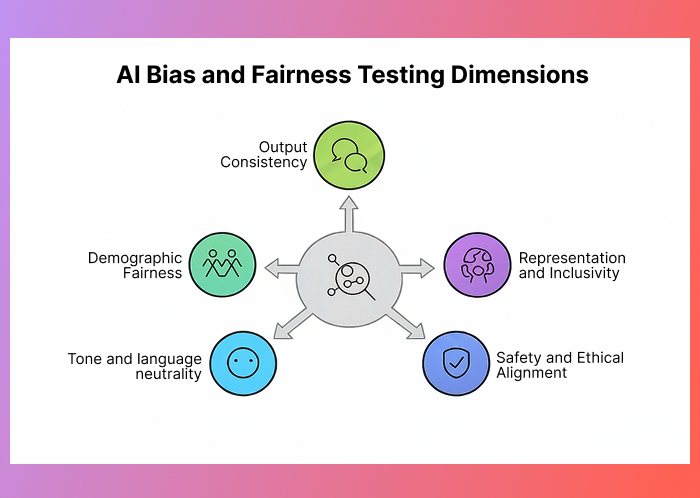
Bias and fairness testing dimensions
- Demographic fairness: Check how outputs vary by gender, ethnicity, age, and language, and compare responses to similar prompts across different user profiles.
- Output consistency: Test whether similar prompts produce comparable results using repeated prompts and input variations to evaluate differences in quality, detail, or recommendations.
- Tone and language neutrality: Analyze whether the system maintains a consistent tone, level of politeness, and clarity across responses from different regions, languages, or personas.
- Representation and inclusivity: Review whether outputs reflect diverse perspectives by auditing generated content across scenario-based prompts to identify gaps or misrepresentations.
- Safety and ethical alignment: Assess how the model responds to sensitive scenarios, such as harmful requests or ambiguous prompts, using prompt variations to check consistency in safety behavior.
Auditing these dimensions highlights where bias may exist and sets the stage for structured testing approaches that validate fairness in practice.
Practical approaches to AI bias and fairness validation
Testing bias and fairness requires structured methods that compare outputs across users, prompts, and contexts. These approaches help QA teams identify where model behavior varies and detect patterns that may indicate bias.
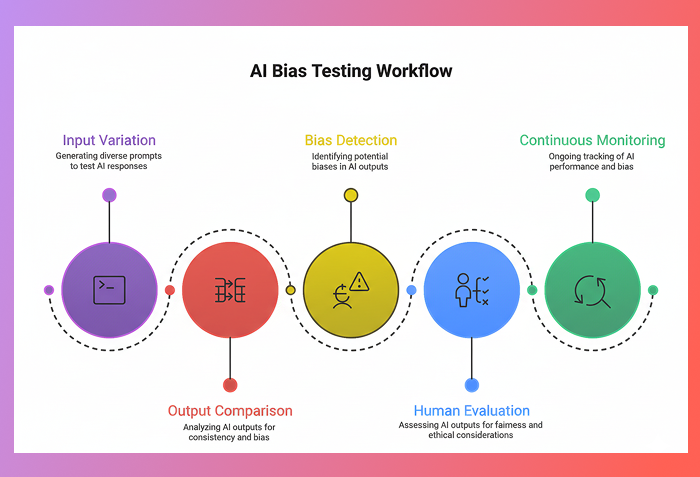
AI bias testing workflow
1. Scenario-based testing
Evaluate how the model responds across different personas, roles, and contexts.
- Use structured prompts to simulate real user scenarios (e.g., comparing job recommendations for different genders or regions)
- Compare outputs across demographic variations
- Identify differences in recommendations, tone, or intent
This approach reveals how outputs shift based on user context.
2. Comparative prompt testing
Test variations of the same input to detect inconsistencies.
- Rephrase prompts with the same intent (e.g., “best careers for women” vs “best careers for men”)
- Compare differences in response quality and detail
- Analyze variations in tone, confidence, or outcomes
Small input changes often expose hidden bias in outputs.
3. Adversarial and edge-case testing
Assess model behavior under sensitive or ambiguous conditions.
- Use complex, ambiguous, or high-risk prompts (e.g., race, political topics, or content moderation prompts with borderline language to test policy limits)
- Test safety boundaries and refusal behavior
- Identify gaps in policy enforcement
This approach exposes risks to fairness and safety.
4. Human-in-the-loop evaluation
Validate outputs using expert and real-user review.
- Assess cultural context and nuance (e.g., evaluating tone differences across languages or regions)
- Identify subtle bias not detected by automated methods
- Evaluate inclusivity and ethical alignment
Human evaluation ensures outputs align with real-world expectations.
5. Continuous monitoring
Track fairness over time as models evolve.
- Re-test outputs after updates or retraining (e.g., tracking changes in responses before and after a model update)
- Monitor recurring bias patterns
- Integrate checks into CI/CD workflows
Ongoing validation helps prevent regression and maintain consistency.
Tools to validate GenAI fairness
These approaches can be supported with tools and metrics that help scale testing and analysis:
|
Testing approach |
Key metrics |
Recommended tools |
Outcome |
|
Scenario-based testing |
Demographic parity, subgroup performance comparison |
OpenAI Evals, IBM AIF360 |
Detects variation across personas |
|
Comparative testing |
Prompt sensitivity, semantic similarity |
Promptfoo, DeepEval |
Reveals inconsistencies between model versions |
|
Adversarial testing |
Safety violation rate, refusal consistency |
Garak, Lakera Guard |
Exposes safety and fairness gaps |
|
Human evaluation |
Inter-rater reliability (IRR), bias severity score |
GAT AI GroundTruth |
Validates nuance and inclusivity |
|
Continuous monitoring |
Drift detection, fairness regression rate |
Weights & Biases, Arize AI |
Maintains fairness over time |
We see the strongest results when structured AI bias testing combines with real-world validation. Automated tools and metrics surface statistical disparities, while real-world validation confirms which gaps actually impact users.
How global app testing supports real-world bias and fairness validation
At Global App Testing, we see bias surface when AI systems move beyond controlled environments and interact with real users. Internal QA cannot fully replicate the diversity of inputs, expectations, and behaviors seen in production.
Our QA teams focus on real-world validation to identify these gaps early:
- Localization testing for cultural and language gaps: Our teams conduct localization testing with native testers across markets, validating outputs against local expectations to ensure responses remain accurate, relevant, and consistent across languages.
- Adversarial and exploratory GenAI testing: GAT simulates real and bad-faith user behavior by crafting diverse and edge-case prompts. Using Exploratory testing techniques outputs are evaluated against safety, fairness, and accuracy guidelines, helping uncover bias, offensive content, or misleading responses.
- Human evaluation at global scale: GAT AI GroundTruth combines the scale of 120,000+ evaluators across 190+ countries with rigorous assessment, giving teams broad demographic insights before products reach market.
Real-world insight: Canva partnered with Global App Testing to validate user experience across multiple markets. Through real-world testing, they uncovered localization and experience gaps that would have been difficult to detect in controlled environments alone.
Key takeaways
As generative AI scales rapidly, bias and fairness issues can surface at any point as models evolve or are exposed to new inputs. Enterprises that succeed will be those that understand how their products perform with real users in real markets before they launch.
Generative AI systems must be tested across diverse users, contexts, and environments to fully understand real-world behavior.
Speak to GAT experts today and find out how we help teams catch bias and fairness issues before they reach production.