





Introduction
What happens when a release passes AI-generated test suites but production users still encounter unexpected issues? As applications expand across devices, regions, and user behaviors, validation complexity increases due to cultural nuances and edge-case unpredictability.
AI testing tools help teams generate tests, detect anomalies, and accelerate validation at scale. However, faster validation does not always guarantee deeper validation.
At Global App Testing, we’ve observed teams increase efficiency with AI tools, only to realise that automated findings still require structured human review before release decisions can be trusted.
This is where human-in-the-loop (HITL) testing becomes essential in AI-driven testing strategies.
In this blog, we explore how combining AI automation with human testing reduces risk and strengthens modern QA strategies.
What is human-in-the-loop testing, and why does it matter for QA?
Human-in-the-loop testing is a structured QA model where AI-generated outputs are continuously reviewed, validated, and refined by human testers.
AI systems can process large test suites, detect anomalies, and surface patterns across test data and builds. However, their outputs are derived from historical data and statistical pattern recognition. This limits AI systems’ ability to interpret business context, user expectations, and evolving organizational priorities.
Human testers bring domain knowledge and regulatory awareness. They ask critical questions that AI alone cannot answer. For example:
- Does this behavior align with user expectations?
- Does this impact business-critical workflows?
- Is this localization accurate in a real regional context?
For QA and engineering teams, human testers:
- Evaluate the relevance of AI-detected issues
- Assess potential business impact
- Prioritise risk based on context
- Interpret AI-generated alerts within a real user journey
GAT insight: Global App Testing QA teams supported Canva's international expansion by providing large-scale localization quality assurance across multiple languages and regions.
Why AI-only testing creates risk in modern QA?
As QA teams adopt AI tools such as GitHub Copilot to generate test scripts or Applitools for visual validation, test suites expand quickly, and release velocity increases. However, accepting AI outputs without structured oversight introduces several risks.
Let’s look at some of the key risks QA teams face:
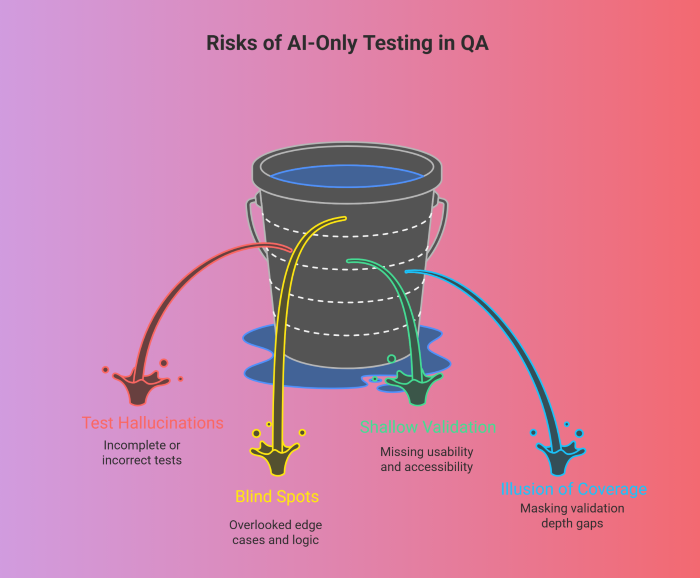
AI-only testing risk overview
- Hallucinated test artefacts: AI-driven test generation tools can produce syntactically valid but incomplete or contextually incorrect test cases that appear executable but fail to reflect real business logic.
- Pattern-based blind spots: Models optimise for patterns seen in training data and past test executions. As a result, they often miss rare edge cases, new workflows, or business-specific rules that fall outside learned behavior.
- Surface-level validation: Automation verifies that features function under expected conditions. It does not capture accessibility issues, localization challenges, or behavioral inconsistencies that only appear during real-world interaction.
- False confidence from automation scale: Executing thousands of AI-generated tests produces strong coverage metrics. That volume alone does not indicate that high-impact risks have been addressed.
Human-in-the-loop testing ensures AI-generated outputs are validated against business context, real user behaviour, and production risk before release decisions are finalised.
What are the benefits of combining AI tools with human testing?
Combining AI tools with human testing allows QA teams to balance automation with human judgment.
For example, Google employs thousands of human Quality Raters to evaluate updates to its AI-powered search algorithms. While AI efficiently processes and ranks billions of webpages, human reviewers evaluate trustworthiness and user intent to ensure automated results meet defined quality standards.
The same principle applies to QA: scale requires oversight to remain reliable.
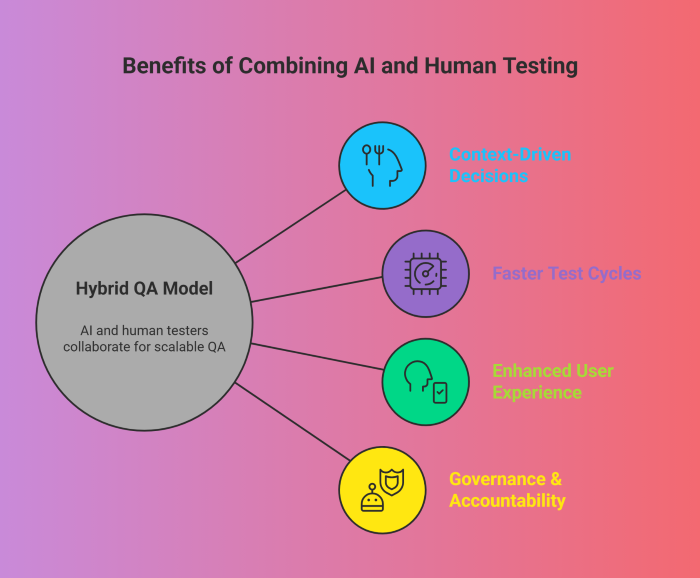
Benefits of combining AI and human testing
In practice, we observed the following benefits when teams adopt this hybrid model:
- Context-aware decision making: AI tools highlight potential issues across large datasets. Human testers provide the context and judgment necessary to interpret these insights, ensuring high-priority defects are addressed before release.
- Faster testing cycles: AI executes repetitive regression suites and visual checks, using automation tools like Selenium or Playwright. Human testers focus on exploratory testing, speeding up the overall cycle without compromising quality.
- Stronger user experience validation: AI can detect functional anomalies, while humans evaluate accessibility, localization accuracy, and subtle usability factors. This ensures the product works technically and provides a seamless user experience.
- Improved control and accountability: AI may generate biased, incomplete, or unsafe outputs. Human intervention ensures findings are explainable, auditable, and aligned with business and regulatory requirements.
Real-world insight: At GAT, our global crowd of testers helped Flip cut their regression test duration by 1.5 weeks. Similarly, we supported Carry1st in improving checkout completion by 12%, aligning automated signals with human insights.
How AI and human testers divide the testing workload
AI and human testers each bring unique strengths to the day-to-day QA workflow. In practice, they work together to balance automation scale with human judgment, improving efficiency and risk coverage.
Let’s look at how AI and humans divide the testing workload:
|
Testing type |
What AI can do |
What humans should do |
|
Regression testing |
Execute large test suites, flag repetitive failures |
Review business impact, validate edge cases |
|
Exploratory testing |
Cover predefined user paths and historical scenarios |
Probe unknown behaviors, test complex user journeys |
|
Security testing |
Run vulnerability scans, detect misconfigurations |
Evaluate exploit scenarios, validate business logic abuse cases |
|
UX testing |
Identify UI inconsistencies and visual differences |
Assess usability, accessibility, and cognitive load |
|
Performance testing |
Simulate load, stress the infrastructure |
Analyse user impact, prioritise optimisation decisions |
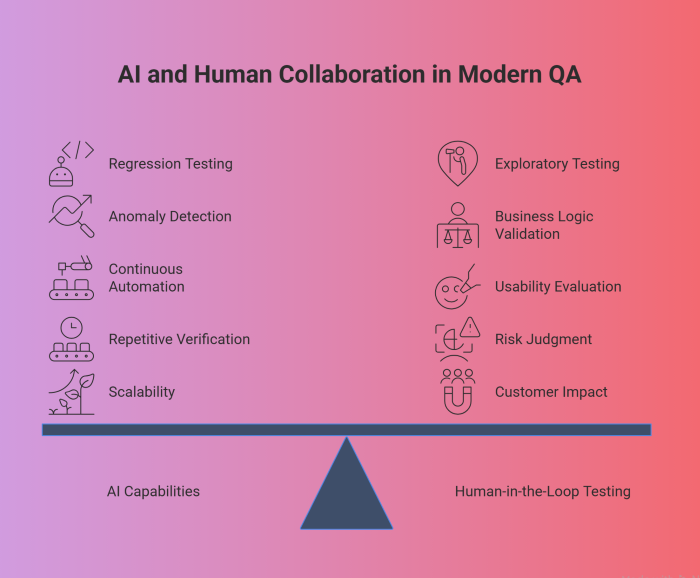
AI and human roles in modern QA
At Global App Testing, we have seen the strongest results when engineering leaders pair AI efficiency with structured human oversight to ensure tests remain aligned with functional requirements and security standards.
How can organisations combine AI and human testing in practice?
AI testing tools help in running thousands of test cases, generating new test cases, detecting anomalies in logs and metrics, performing visual comparison, etc., whereas human insight is essential for exploratory testing, edge case detection, UX validation, localization testing, and ethical judgment.
Organizations combine these two strengths to define areas covered by AI testing and human testing.
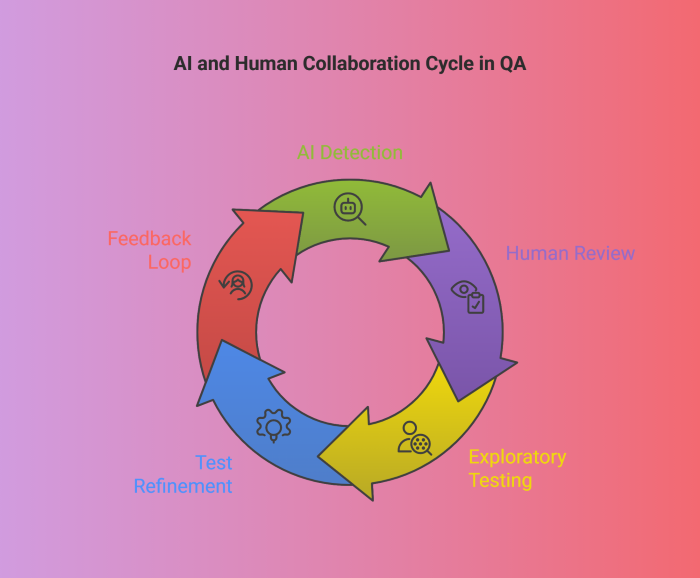
AI and human collaboration in production workflows
To ensure maximum productivity of QA teams, we recommend following the workflow for structured collaboration:
- AI-first detection: AI performs large-scale anomaly detection and pattern analysis. Humans validate high-risk or low-confidence outputs before release.
- Human-validated test generation: AI tools generate test cases based on usage patterns. QA engineers review and refine test cases to align with business objectives and close contextual gaps before execution.
- AI-assisted triage: When defects are logged, automation clusters similar issues and detects recurrence patterns across environments. QA leads use this data to assess severity, user impact, and operational risk to prioritise effectively.
- UX and Exploratory testing: AI covers predictable and repeatable test paths. Human testers explore integration dependencies, localization gaps, and complex user behaviour.
By combining automation with human intervention, organisations can reduce manual repetition while preserving control over release risk and quality decisions.
Ready to operationalise AI-human testing with GAT?
Global App Testing enables engineering and QA teams to strengthen AI quality assurance through expert human evaluation in live production environments. The goal is simple: greater release confidence, stronger governance, and validation that withstands enterprise security.
We deliver validation across real devices, regions, and usage contexts through our global crowd testing network. With access to more than 90,000 professional testers across 190+ countries, organisations gain real-world coverage that strengthens AI-driven and traditional testing workflows.
GAT supports testing AI systems with structured human validation, including:
- Adversarial prompt testing to uncover vulnerabilities, hallucinations, and unsafe outputs
- Human preference ranking to evaluate output quality, relevance, and contextual alignment
- Reinforcement Learning from Human Feedback (RLHF) to improve model performance through continuous human feedback.
Ready to amplify your AI-human testing strategy? Book a demo to see how Global App Testing can strengthen your AI testing strategy with human validation, helping you reduce risk and release better software faster.