





A banking assistant assigning inflated credit limits or a healthcare system suggesting incorrect treatment can result in financial or patient-level risk. AI hallucinations occur when AI systems generate incorrect information with high confidence. These errors can result in financial, legal, and reputational liabilities while reducing user trust.
Traditional QA methods struggle with these nuances, for instance, during QA testing of a fintech chatbot, ambiguous financial queries were used to surface inconsistent and incorrect responses that structured test cases may not detect.
AI hallucination testing focuses on identifying and eliminating such incorrect or misleading outputs before deployment, ensuring AI systems behave reliably under real-world conditions.
In this blog, we discuss how AI hallucination testing works, why traditional QA methods fall short, and how teams can combine automation with human validation to ensure reliable AI outputs.
Why AI hallucinations happen
AI systems hallucinate because models produce responses based on linguistic probabilities over verified facts. They can also arise due to limitations in training data, a lack of grounding in real-time information, and difficulty handling uncertain or unfamiliar inputs.
To overcome probabilistic challenges, we at GAT combine automated checks with human oversight to catch errors early, ensuring outputs are reliable, safe, and meaningful for real users.
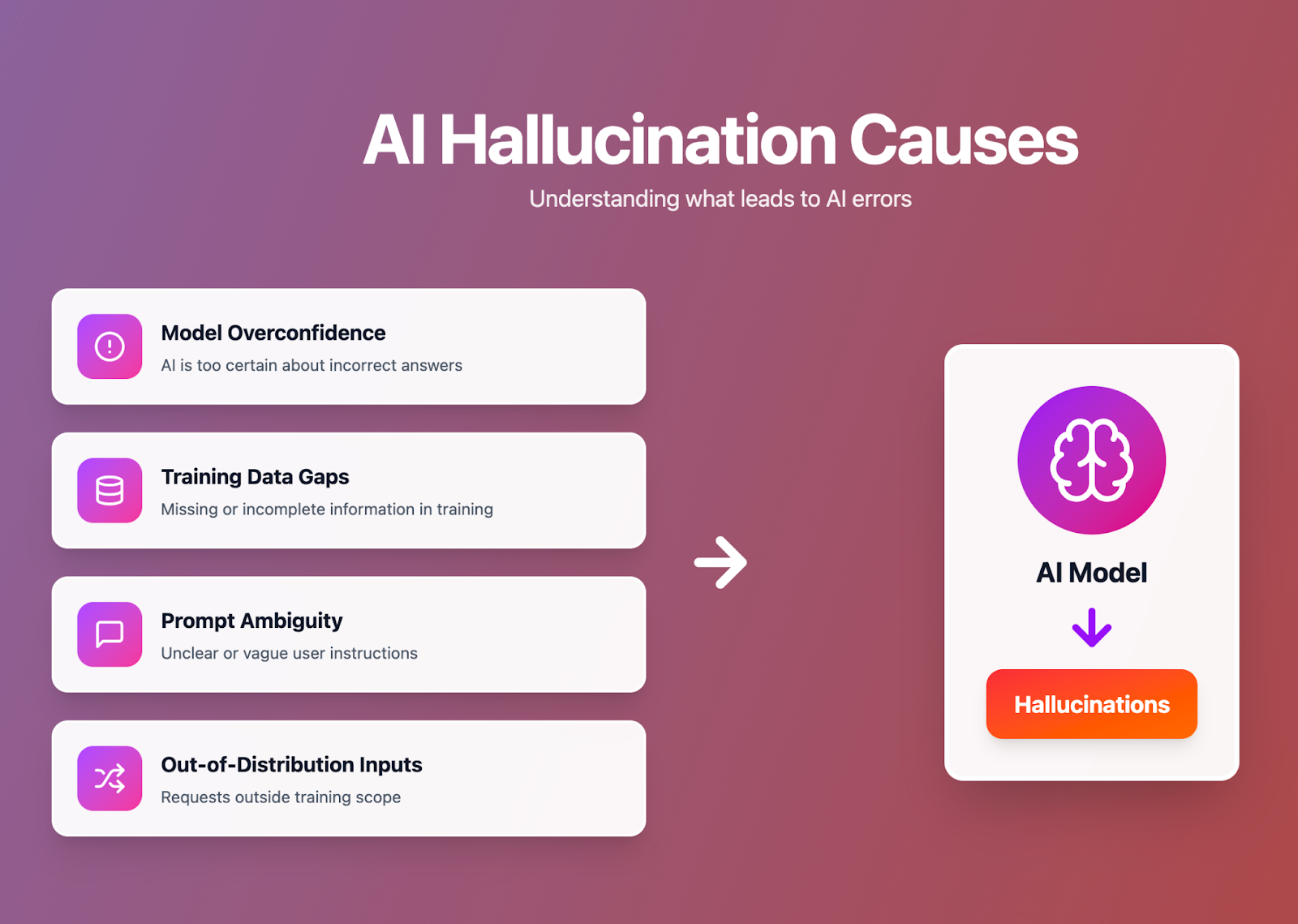 Root Causes of Hallucinations
- Model overconfidence: AI models can present incorrect answers with confidence. For example, a banking chatbot might confidently state a customer’s available credit limit incorrectly, leading to poor financial decisions.
- We validate outputs against trusted sources and flag any discrepancies between the system’s confidence and actual accuracy, reducing the risk of misleading users.
- Training data gaps or bias: A model is only as good as the training data. If specific medical conditions, niche demographics, or regional dialects are underrepresented, the model will output incorrect and incomplete information.
- In an AI-driven fraud detection system, the model relied on historical data, causing false declines and missed emerging fraud patterns. Through real-world scenario testing, Global App Testing uncovered training data gaps, enabling improved accuracy and user experience.
- Prompt ambiguity: Users rarely provide perfectly phrased queries. Vague or contradictory prompts can trigger hallucinations. For instance, a virtual assistant may give unsafe guidance if a symptom description is unclear.
- Exploratory QA approaches are used to evaluate AI systems under ambiguous and edge-case inputs to identify inconsistent outputs before release.
- Out-of-distribution inputs: Real-world users often ask questions outside the model’s training domain. A travel assistant might struggle with a destination that opened after its training cutoff.
- Edge-case simulation is used in GAT-led testing to evaluate AI reliability under inputs the system would not typically encounter.
Identifying root causes, e.g., stale training data, ambiguous prompts, etc., that trigger hallucinations is the first step that naturally follows a rigorous testing framework to resolve the problem. However, let's first understand the limits of traditional QA.
Why traditional testing falls short in detecting AI hallucinations
Traditional QA methods are designed for predictable, rule-based systems. However, AI-driven systems are non-deterministic and context-dependent, which makes traditional validation redundant.
Why traditional testing fails
Conventional QA methods are built on determinism; input A must always retrieve output B. However, AI systems are probabilistic; their responses are dynamic, multimodal, and context-dependent.
Static test scripts break down and create validation gaps that allow hallucinations to slip into production.
Core challenges
- No single “expected output”: Even the same prompt can produce multiple valid but different responses, making pass/fail checks unreliable.
- Inconsistent outputs: Manual testing cannot scale to cover thousands of variations that AI can generate.
- Complex content types: Text, images, and code all require nuanced evaluation that standard QA scripts cannot handle.
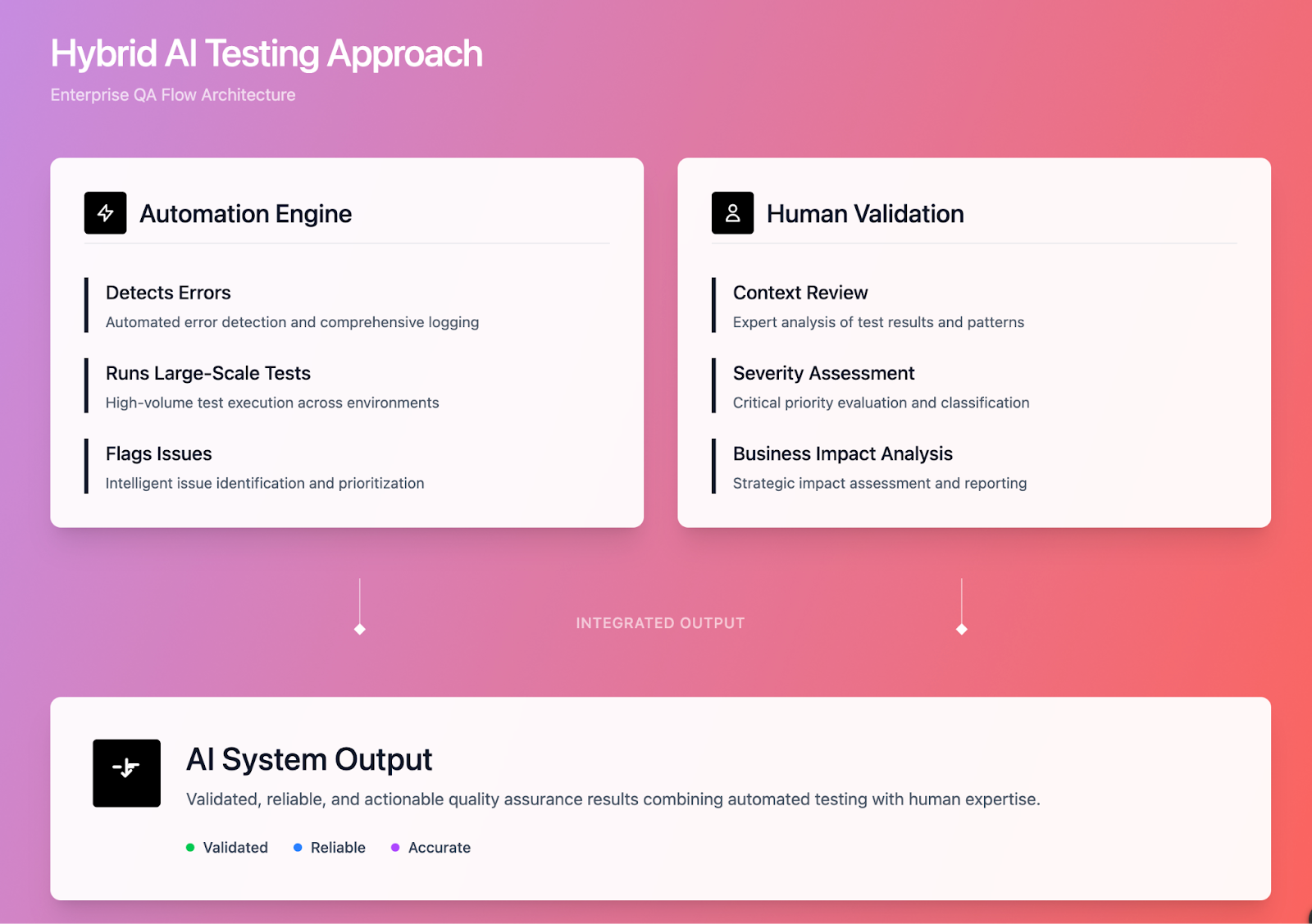
Hybrid AI Testing Model
Why human + AI validation is needed
A hybrid approach combines the velocity of automated detection with the nuance of human validation to assess both technical accuracy and real-world risk.
For example, an AI-powered customer support chatbot may generate a confident but incorrect response about a refund policy. Automated checks can flag inconsistencies against knowledge bases, but human testers in real-world scenarios are needed to assess the business impact, such as misleading customers or policy violations.
Combining automation with human validation closes the gaps left by traditional testing. This ensures AI systems are both scalable and reliable in real-world use.
GAT framework for AI hallucination testing
As mentioned earlier, a rigorous testing framework is required to close the context gaps and catch hallucinations. However, applying a framework only works when it reflects real user behavior and business risk.
Hallucinations rarely appear in controlled scenarios; they surface where accuracy matters most in AI systems. At Global App Testing, we use the following approach in production-like conditions to ensure outputs are accurate and reliable.
- Define high-risk scenarios: Focus on finance, healthcare, and compliance-driven use cases because errors here directly impact users and regulatory compliance. In a healthcare project, we observed that a testing dosage guidance in critical scenarios exposed unsafe outputs early, before they reached users.
- Design input coverage: Use prompts that are ambiguous, partial, and boundary condition-based, since real-world users almost never pose perfect queries to an AI system. For example, exploratory and edge-case testing in real-world environments helps uncover inconsistent and unexpected AI behavior that structured test cases often miss.
- Apply human validation: Automation flags issues, but humans assess context and severity. In practice, domain experts identify unsafe recommendations that require intervention before release in AI-driven workflows.
- Validate output: Ensure all claims are backed by verified ground truth data or authoritative internal sources to maintain accuracy, reliability, and decision-grade quality.
- Metrics and reporting: Measure hallucination rates using a ground-truth reference dataset, severity scores, and detection time. Teams can track them through evaluation pipelines with logging systems and dashboards that compare outputs against verified data. This enables teams to identify failure patterns and monitor reliability over time.
- Continual improvement: Optimize your prompts and test cases when failures occur. Since your AI model, data distribution, and users change, your testing needs to keep up.
- Traceability: Trace all inputs, outputs, and results of your validations for compliance reasons and more efficient testing next time.
GAT Approach: We employ a hybrid approach that pairs large-scale automation with critical human oversight. This reduces production risk, strengthens confidence in AI outputs, and enables teams to release with greater trust.
AI testing tools and techniques for hallucination detection
Hallucination testing requires structured validation techniques that help teams detect inconsistencies, verify factual accuracy, and reduce unsafe outputs.
QA teams commonly use the following methods in production-grade AI environments to detect and reduce hallucinations.
|
Technique |
Why it matters |
How it works |
Example |
Impact |
|
Output consistency testing |
Detect unstable outputs that change across executions |
Run the same prompt multiple times and compare variations |
The clinical decision support tool gives inconsistent drug contraindication results across runs |
Inconsistent outputs can lead to wrong user decisions, reduced trust, and increased support costs. |
|
Ground-truth validation |
Ensures factual correctness instead of pattern-based responses |
Validates outputs using APIs, databases, or verified knowledge sources |
Financial chatbot returns different tax treatment rules for the same transaction query across runs |
Misleading financial guidance can violate regulatory compliance, trigger financial penalties, etc. |
|
Pattern and anomaly detection |
Identifies unsafe, illogical, or high-risk responses early |
Applies rule-based or ML-based anomaly detection on outputs |
Unsafe guidance due to incorrect weight-based dosing logic and missing pediatric safety constraints. |
Unsafe outputs can result in legal liability, patient harm, and serious reputational damage in high-risk domains like healthcare. |
GAT perspective: Automation helps surface issues quickly across large sets of AI outputs, while human validation ensures those issues are understood in context and evaluated for real-world risk, making AI QA both scalable and reliable.
What this means for AI reliability and risk
AI hallucinations testing will impact trust, compliance, and income, making structured testing essential to business operations. Otherwise, erroneous output may reach users, with dire consequences.
Strong testing works best when it follows a hybrid approach:
- Blend automation with human review because scale alone misses context, while humans alone can’t cover volume.
- Focus on high-risk and edge-case scenarios, as they carry the greatest business and safety impact.
- Measure what matters, such as hallucination rate, severity, and false positives, to guide decisions.
- Continuously refine test coverage as models, prompts, and user behavior evolve.
We use this approach in real-world delivery environments. This balance helps teams catch critical failures earlier and improve confidence in releases across regulated and high-stakes domains.
Speak to our team to understand the AI hallucination testing framework to prevent false information from slipping into production, harming your business outcomes and users.