





In enterprise environments, neither a suite of 1,000 test cases, nor 90% UI automation, nor even a 100% pass rate truly guarantees software reliability. Our experience shows that successful global releases depend on more meaningful indicators: the breadth of cross-device testing, coverage across local languages and regions, the extent of concurrent testing, and the thoroughness with which edge and corner cases are identified and validated.
At Global App Testing, engineering teams validate software continuously across devices, regions, and platforms, enabling them to detect risks early, focus on high-value development, and release reliable software. Our core goal remains reliability: we ensure users experience software that works as expected.
This blog highlights why QA is essential in modern software delivery, how teams can scale testing efficiently, and when outsourcing adds strategic value.
What are software testing and QA services?
Software Testing is the activity of assessing an application to identify defects and verify that its functionality meets expectations. The QA Services test software functionality for reliability and correctness in line with the business objective.
A comprehensive QA services model typically includes:
- Functional and regression testing
- Performance and scalability validation
- Security and compliance testing
- Usability and accessibility testing
- Automation testing to support frequent, reliable releases
- Localization and cross-device testing using real users across regions and environments
Using professional QA services enables teams to:
- Shift testing left to identify and resolve risks sooner
- Ensure adherence and compliance with regulatory standards
- Find issues early in the development cycle
- Prevent costly problems after deployment
- Maintain consistent quality across updates
- Accelerate time-to-market with assured reliability
- Deliver reliable software that performs as expected for end users
Why QA services matter in modern software development?
Rapid application development and delivery require quality assurance throughout the process, not at the end, because changes may introduce high-cost, high-disruptive errors across the application development life cycle stages.
Embedding QA into delivery pipelines enables teams to:
- Shift testing left to catch risks early
- Continuously validate changes with automation
- Reduce production incidents and emergency fixes
- Foster collaboration between development and QA
Integrated QA goes beyond error reduction by enabling faster releases, early risk detection, automated validation, and more reliable collaboration at scale.
Understanding full-cycle QA: A blueprint for excellence
Full-cycle QA services embed quality across the application lifecycle, from requirements analysis to post-launch, enabling teams to make proactive quality decisions.
Phases of Full-Cycle QA
|
Phase |
Purpose |
Value delivered |
|
Requirement Review |
Validates acceptance criteria and risks |
Reduces misalignment and costly rework by ensuring requirements support business objectives. |
|
Test Strategy Design |
Aligns testing with product goals |
Concentrates QA efforts where risk and value are highest, improving efficiency and outcomes. |
|
Manual & Automated Testing |
Validate functionality and workflows |
Enable fast, reliable releases that meet user expectations. |
|
Regression Testing |
Protects existing functionality |
Maintains stability for critical features, safeguarding customer trust and minimizing post-release incidents. |
|
User Acceptance Testing |
Confirms readiness for users |
Ensures product readiness, reducing launch risk and boosting adoption. |
|
Post-Release Monitoring |
Observes real-world usage across devices and regions |
Identifies opportunities for improvement, supporting continuous enhancement and sustained market performance. |
Through full-cycle QA and real-device crowdtesting, Global App Testing helps teams validate software where it matters most in real user environments. This reduces unexpected issues after release while allowing teams to maintain delivery pace without compromising quality.
How does QA testing boost software quality?
QA testing supports development from start to finish by validating software across devices and real-world usage scenarios. Catching problems early improves overall release reliability.
Effective QA testing helps teams to:
- Spot defects early to prevent problems and minimize rework
- Align on business and technology requirements so that the product meets its intended purposes
- Enhanced release stability and predictability for faster and safer releases
- Make sure to provide a uniform user experience
The QA tests conducted in web, mobile, API, or enterprise environments provide valuable insights that improve product quality and ensure sound releases. The shorter the cycles, the more critical a structured QA strategy is to development.
Types of QA testing and when to use them
Teams achieve broader coverage by applying a combination of testing methods within their QA strategy.
|
Testing Type |
Purpose |
Best used when |
|
Validates features and workflows |
New functionality and enhancements |
|
|
Protects existing behaviour |
Frequent releases |
|
|
Measures speed and stability |
High-traffic or scalable systems |
|
|
Identifies vulnerabilities |
Data-sensitive applications |
|
|
Evaluates user experience |
Customer-facing products |
|
|
Acceptance Testing |
Confirms business readiness |
Pre-release validation |
|
Verifies backend logic |
Service-driven architectures |
|
|
Simulates security attacks |
Compliance-driven industries |
Determining the product’s maturity, risk, and delivery cadence is an appropriate combination of these approaches. While selecting a QA strategy is necessary, having the right team in place is equally decisive in turning strategy into high-quality results.
Building a high-performance QA team
Skilled QA professionals with well-defined roles ensure a department’s success. All these roles contribute to the quality of the final product, including but not limited to testing and orienting the QA process.
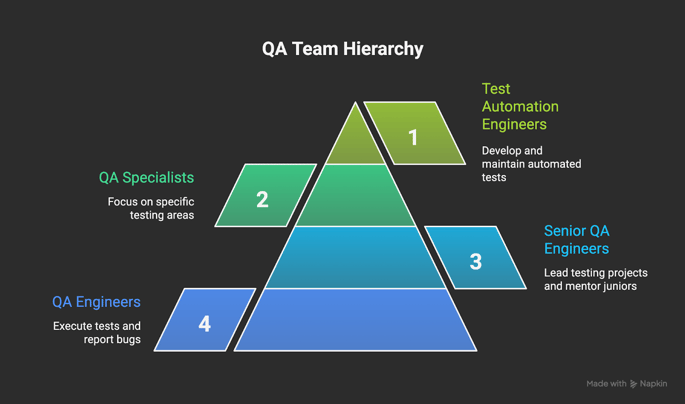
High-Performance QA Team
QA tasks involve:
- QA Engineers: Run tests, record bugs, and verify fixes.
- Senior QA engineers: Determine testing direction and execution.
- QA Specialists: Provide domain, platform, or compliance expertise.
- Test automation engineers: Design and development of automation frameworks.
Consistency comes from defining roles, fostering open communication, and leveraging expert skills, with automation then accelerating the pace.
Test automation: Scaling QA with speed
Test automation shortens feedback cycles and supports CI-driven releases, delivering clear value in regression, workflow, and high-throughput testing.
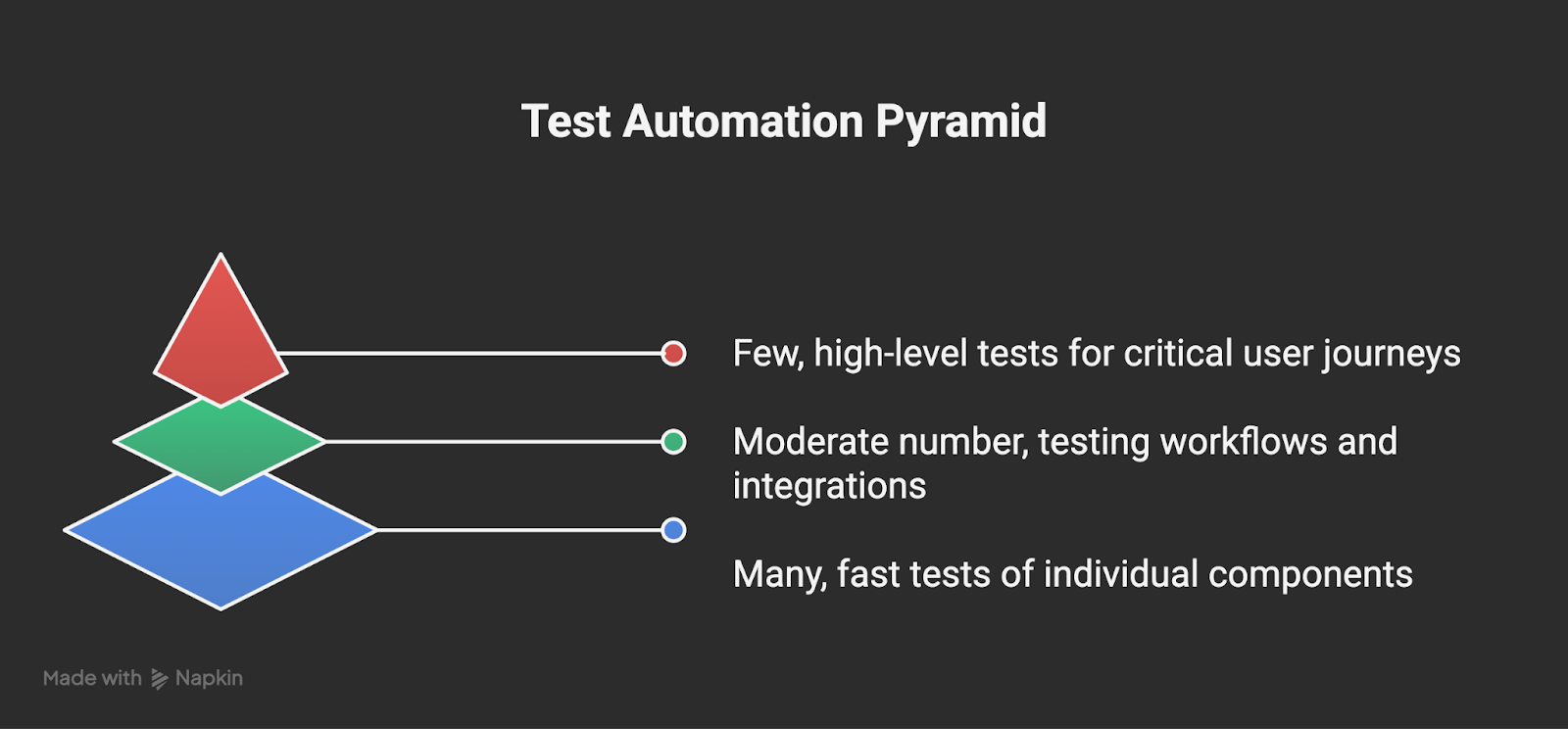
Test Automation Pyramid Model
A common approach is the Test Automation Pyramid, which emphasizes:
- Unit tests at the base: Fast, frequent tests of individual components
- Service/API tests in the middle: Validate integrations and workflows
- UI/end-to-end tests at the top: Fewer, higher-level tests for critical user journeys
Automation is most effective when applied strategically, such as:
- Regression tests that protect existing functionality
- Smoke tests to verify basic workflows before release
- High-volume or repetitive tasks, like bulk data validation
- Cross-platform or cross-browser checks to maintain consistency
Applied thoughtfully, automation strengthens QA by:
- Shortening feedback loops to catch issues sooner
- Expanding test coverage across platforms
- Reducing repetitive manual work, freeing teams for exploratory testing
- Increasing confidence in each release, supporting stable, reliable software
Automation speeds up testing, but manual testing is crucial for exploration, usability, and complex edge cases. Combining both with experienced QA teams balances speed, cost, and quality.
When to outsource QA services?
Outsourcing QA gives organizations access to specialized skills, the ability to scale quickly, and the ability to stay focused on core development. It’s especially valuable when in-house expertise is limited, release timelines are tight, or testing spans multiple platforms or regions.
Common reasons to outsource:
- Limited internal testing skills
- Accelerated release schedules
- Cross-platform or global coverage
- Cost and resource management
Engineering teams working with GAT gain scalable QA coverage across platforms and regions, helping maintain release speed without compromising quality. Transparent reporting and risk-based insights support thorough validation while keeping teams focused on development.
A reliable QA partner provides systematic testing, clear updates, and deep domain knowledge. Careful evaluation of potential partners helps teams achieve better outcomes and choose the right testing provider.
What to look for in a software testing company?
It takes more than capability to choose the right testing partners effectively. The best partners are like an extension of your team, helping with strategy as well as delivery.
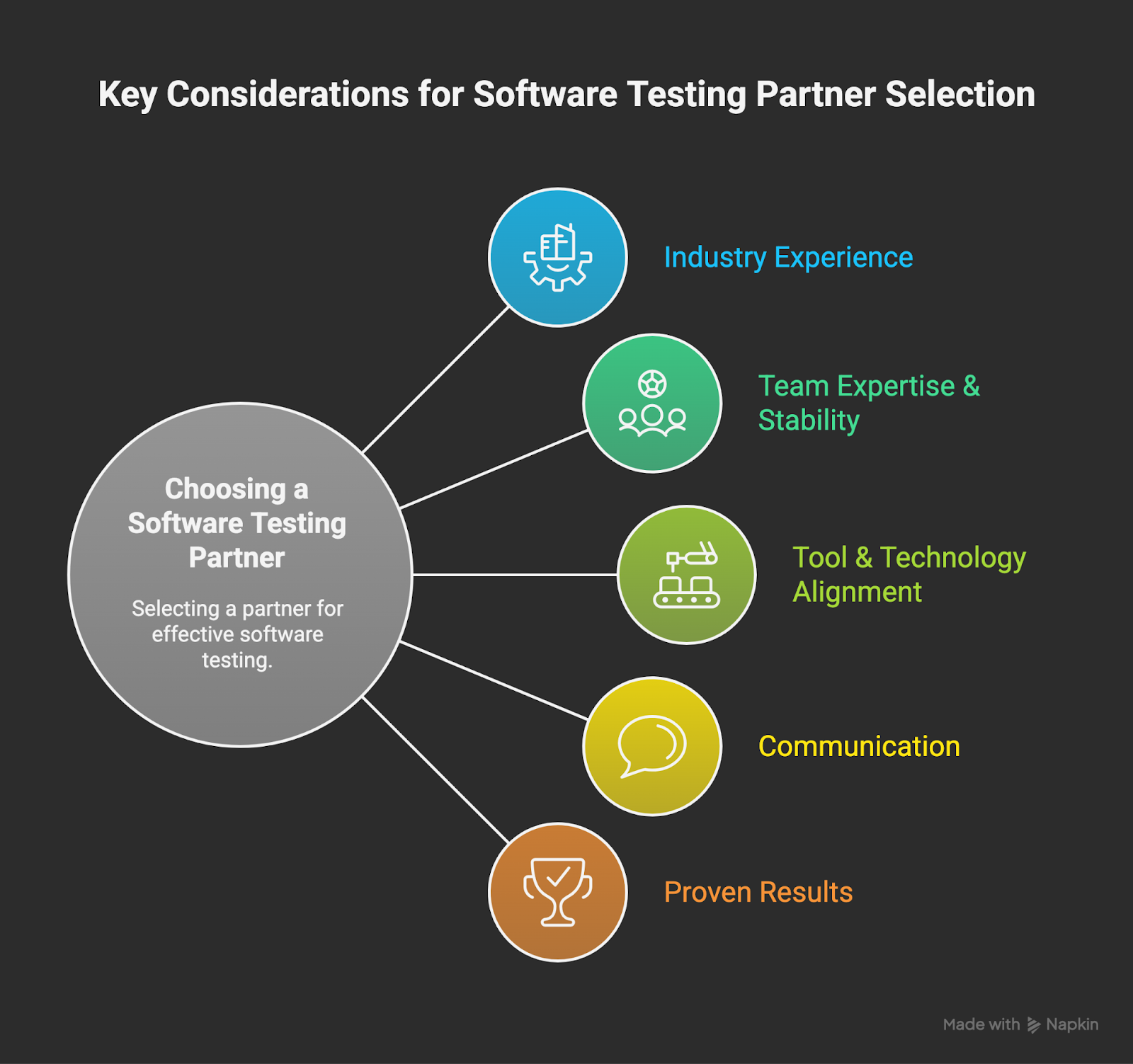
Choosing the Right QA Partner
The following are some of the key considerations:
- Industry experience: Ensure the person handling your data has relevant domain knowledge.
- Team expertise and stability: Experienced and qualified QA teams.
- Tool and technology alignment: Compatibility with your tech stack and processes.
- Communication: Effective reporting, proactive reporting, and risk alerts.
- Proven results: Verified delivery outcomes and case studies.
An effective partner not only runs tests for you but also provides insights to inform your QA strategy, which forms the basis for a software testing approach that permeates quality across all stages.
Choosing the proper QA and software testing strategy
An effective QA strategy aligns with business objectives. Factors to be considered by organizations include:
- Product lifecycle stage: Align test efforts with the development stage and release timelines.
- Market & customer expectations: Emphasize what can or should add the most value.
- Regulatory requirements: Ensure compliance in regulated industries, including finance, healthcare, and e-commerce.
- Team maturity: Align QA processes and tools with in-house skills and capabilities.
Regular measurement and iteration of test coverage, defect trends, and QA processes ensure that the QA process remains practical and relevant to evolving products. There are testing tools available to maximize efficiency and product quality as part of an effective strategy set up for success.
Testing tools and resources for QA success
Effective QA relies on the right combination of tools to manage test execution, automation, and reporting. Key tools include:
|
Tool |
Purpose |
|
Selenium / Cypress |
Test automation |
|
JMeter |
Performance testing |
|
Postman |
API testing |
|
OWASP ZAP |
Security validation |
|
TestRail |
Test management |
|
Jira |
Defect and sprint tracking |
Tools are most effective when paired with structured processes and experienced teams. This approach ensures testing drives reliable releases, supports faster feedback, and strengthens overall product quality.
Software QA and business outcomes
QA has direct effects on business outcomes rather than merely being a technical verification. High-quality software eliminates support expenditures, downtime, and customer distrust.
Key advantages are:
- Fewer incidents of production
- Greater customer satisfaction
- More rapid resolution of issues
- Enhanced Stakeholder Confidence
Great QA is a powerful resource that drives revenue protection and growth. They could be most important to the industries that must adhere to government and other legal and security norms.
QA and testing services for regulated industries
Engineering leads in finance, healthcare, and e-commerce are responsible for making sure software complies with rigorous regulatory and security standards. QA and testing go further than core functionality by focusing on:
- Adherence to compliance requirements: Verify that the software meets legal and industry standards.
- Audit preparedness: Keep systems ready for reviews and regulatory inspections.
- Secure critical data: Protect sensitive information consistently.
- Maintain system resilience: Test software to ensure reliable performance under real-world and peak-usage scenarios.
Partnering with an experienced software testing company gives engineering teams the expertise and structured processes to meet user expectations and regulatory requirements, enabling compliant and reliable releases on schedule.
Case study snapshot: Full-cycle QA in action
To strengthen software quality without slowing delivery, a SaaS startup worked with a QA and software testing partner that applied a full-cycle testing model across each stage of development, including:
- Automated regression testing to quickly catch recurring issues
- Manual usability checks focused on clarity, ease of use, and user flow
- CI/CD pipelines built to support continuous testing as development progresses
- Nightly performance testing to monitor system stability under real-world conditions
Impact: The startup cut post-release defects and moved faster through sprints. Global App Testing achieved comparable results with Airportr, saving the team an entire sprint day and strengthening release confidence.
Summary: Software testing and QA services in 2025 and beyond
In today’s fast-paced development environment, delivering Integration Quality (IQ) across the entire software lifecycle is critical. Companies that embed IQ at every stage, not just final acceptance, can manage growth and stay competitive.
By adopting a full-cycle QA approach with end-to-end testing, automation, and strategic validation, teams achieve stable software and reliable releases. Global App Testing helped Booking.com streamline testing and improve coverage, reducing post-release issues and increasing release confidence across devices and regions.
Key takeaways
- QA is a strategic capability, not a support task.
- Full‑cycle QA reinforces quality throughout the development lifecycle.
- Purposeful automation speeds feedback and releases.
- Outsourcing QA provides access to skills, scale, and expertise.
- The right testing partner delivers insight alongside execution.
Investing in QA today builds reliable, future‑ready software and strengthens market competitiveness. Scale your software delivery with confidence. Partner with GAT’s QA experts to boost reliability and user trust.