





Suppose a team launches an AI-powered feature such as a chatbot or recommendation engine. Initial testing looks successful, but after a model update, responses start behaving differently across devices and regions.
The testing tool still reports acceptable metrics, yet real users encounter broken flows and inconsistent outputs.
This situation highlights a growing challenge in AI development. As models evolve rapidly and teams experiment with multiple providers, testing strategies that are tightly structured around specific tools or isolated workflows can limit visibility into real product behavior.
Tool-agnostic AI testing addresses this problem by separating testing logic from the platform. Instead of relying on one tool, teams design validation scenarios that can run across models, environments, and user contexts.
This approach offers:
Better interoperability
Stronger validation
Long term independance
At Global App Testing, we enabled Airportr to expand its validation across 17 countries and a wide range of devices. This helped them uncover UX and edge-case issues while saving approximately one day per sprint cycle in testing effort.
In this article, we explore why tool-agnostic AI testing matters and outline practical frameworks for efficiently scaling AI validation.
What is tool-agnostic AI testing?
Tool-agnostic AI testing separates QA validation from specific platforms, ensuring your testing strategy remains effective even if the underlying model or stack changes.
This approach enables AI testing independence and helps teams to validate outputs such as AI-generated responses or predictions. It also evaluates behaviors like response accuracy and contextual relevance across devices and regions.
Traditional tool-centric testing focuses on APIs or automation scripts, while tool-agnostic frameworks apply core quality criteria like accuracy, edge-case handling, and localization behavior across tools and environments to catch edge cases, localization issues, and real-user problems.
For example, when LiveSafe partnered with Global App Testing, we helped them test their safety app across 45 cities in 19 countries, starting with 11 testers in two countries. This real-world testing uncovered issues automated checks might miss, providing reliable insights into app performance and user journeys across diverse devices and environments.
Operational constraints in rigid AI testing setups
As AI systems evolve across models, platforms, and user contexts, testing strategies that are narrowly scoped can create friction. Teams that rely on rigid or tool-specific workflows often face multiple challenges.
These include:
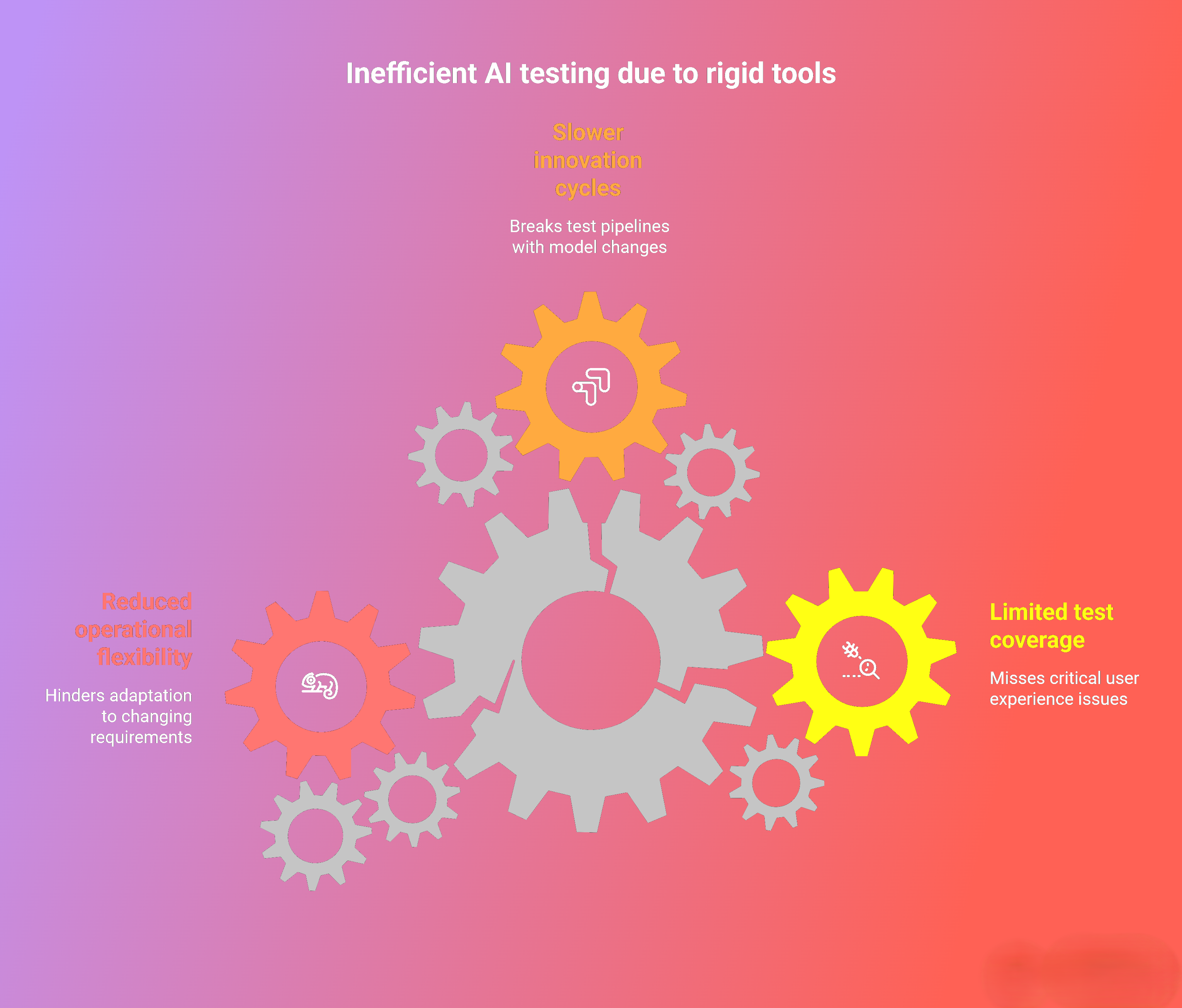
Inefficiencies in rigid AI testing
1. Limited test coverage
Some AI testing tools focus primarily on prompt validation or accuracy metrics. They can overlook:
- Broken user flows caused by AI responses
- UI issues triggered by unexpected outputs
- Localization problems in different regions
- Context misunderstandings in real conversations
Without broader testing, these issues reach production.
2. Slower innovation cycles
Companies frequently evaluate new AI models or update existing ones. For example, a team can choose to move from GPT models to alternatives like Claude or Gemini depending on their performance and capabilities.
So if testing frameworks depend on a specific tool, these changes can break the existing test pipelines. Hence, the QA teams will have to spend more time rebuilding tests rather than validating new features. This adds friction to iteration and deployment.
3. Reduced operational flexibility
Changes in APIs, feature sets, or compliance requirements may require adjustments to testing workflows. These factors can affect how easily teams adapt their testing processes.
Testing strategies should be more adaptable as AI initiatives expand. Greater flexibility will support scale and consistent validation across evolving AI ecosystems.
Why AI testing independence enables scale
AI testing independence lets teams keep pace with evolving technology without rebuilding QA foundations each time they adopt new tools or models. This flexibility turns potential bottlenecks into opportunities for faster iteration and broader validation. Here is how it helps:
Model flexibility
Teams can swap models when testing is not tightly coupled to a single provider. They can also validate outputs from different AI providers and extend coverage across devices, platforms, and environments with minimal disruption.
Cross-platform and real-world testing
Independent frameworks support testing across web, mobile, and other platforms while accommodating diverse geographies. This ensures consistent AI behavior for a wide range of users.
Our team helped Canva expand its testing across languages and devices, increasing global reach while maintaining release confidence and supporting AI systems operating in diverse markets.
Human-in-the-loop validation
Tool-agnostic strategies also make room for human-in-the-loop validation. It recognizes that automation alone cannot catch context issues, cultural mismatches, or safety concerns. Real human testers can help to uncover gaps that scripted checks often miss and improve the overall confidence in AI behavior.
Our global tester network validates AI systems in real-world conditions. GAT’s crowdtesting and structured AI validation offer real-world confidence.
For example, we helped Carry1st in uncovering regional UX and validation gaps, leading to a measurable 12% increase in checkout completion rates across local payment environments.
A practical framework for tool-agnostic AI testing
Organizations adopting AI systems benefit from testing frameworks that remain adaptable as models, platforms, and user environments evolve. A structured approach can help teams to validate their AI features consistently while maintaining development velocity.
-2.png?width=2589&height=2109&name=download%20(1)-2.png)
Tool-agnostic AI testing framework
Step 1: Separate AI model validation from UI testing
Start by testing AI outputs independently from the application interface. Teams can evaluate prompts, responses, and model behavior without involving the full user interface. Once the model performs reliably, integrate testing into complete user journeys across apps or workflows.
Step 2: Combine automated + human testing
Automation plays an important role in regression, smoke, and sanity testing. However, AI systems also require human validation. Real testers can detect tone issues, contextual errors, cultural mismatches, and unexpected responses that automated checks may overlook. Crowdtesting provides real-world feedback across devices, regions, and user environments.
Step 3: Implement layered validation
AI-enabled applications benefit from layered validation approaches, including:
- Functional testing
- Regression testing
- Bias and safety testing (red teaming, adversarial testing, fairness audits)
- Localization testing
- Performance testing
This layered structure ensures AI systems are evaluated from both technical and user-experience perspectives.
Step 4: Maintain agile alignment
AI testing should evolve alongside product development. Integrating validation into CI/CD pipelines enables teams to test continuously and release new features quickly.
At Global App Testing, we align structured testing cycles with agile development workflows so AI validation keeps pace with rapid product iteration. Teams working with GAT can achieve up to 50% faster sprint cycles and save up to 70% of QA lead time, demonstrating the operational impact of scalable and real-world validation.
For example, our team at GAT helped Facebook scale testing dramatically. We helped them expand validation across thousands of partner apps within the same time window, demonstrating how flexible testing frameworks support large-scale ecosystems.
How GAT enables tool-agnostic AI Testing at scale
Global App Testing enables companies to validate AI systems at scale by combining structured processes with real-world coverage. Our global crowdtesting network ensures testing across diverse devices, geographies, and user conditions, providing insights that automated scripts alone may miss.
Testing cycles are designed to align with agile and Scrum workflows, enabling continuous validation as products evolve. Teams can assess AI features in production-like environments, covering regression, exploratory, localization, and user experience testing.
Reach out to us to implement a tool-agnostic AI testing strategy and gain confidence in your AI deployments!