





Imagine a company expanding its product from a local market to global users. While the in-house QA team understands the product well, the sheer variety of global devices and localized network conditions creates a blind spot that in-house teams can't cover. This is where software testing and QA services become essential.
Software testing and QA service providers such as GAT help enterprises establish an in-depth testing strategy that includes functional, localization, UX, and cross-device testing. It enables teams to overcome the shortcomings of in-house teams by leveraging a global crowd of real testers and running tests on real-world scenarios.
This guide will cover how QA services improve product quality and how QA service providers enable global releases for enterprises.
What are QA services and why do they matter?
QA services ensure products are reliable, user-friendly, and market-ready. They help organizations confidently expand from local to global releases by reducing risk, improving performance, and maintaining quality across markets.
Here is why QA services are important:
- Payment testing: E-commerce applications require validation with real banking cards from different regions. QA services make this possible by bringing together testers from across the globe, ensuring secure, reliable, and region-compatible payment experiences.
- Protect user experience: With QA service providers like GAT, teams ensure that their applications’ user experience is compatible with users regardless of age, background, language, or device.
- Support faster releases: Crowdtesters help teams complete QA cycles quickly by working side by side.
- Compliance and traceability: Structured QA helps meet industry requirements for documentation and audit evidence.
Check how our teams helped Carry1st improve their checkout completion by 12% by testing the application with 120+ payment methods worldwide.
How do QA and software testing services improve product quality?
In-house teams often focus on core features, leaving performance and regional coverage gaps. QA and software testing services extend validation across devices, networks, and user scenarios, helping uncover defects early and ensure stable, reliable releases.
The table below shows how common QA activities contribute to better product quality.
|
QA activity |
Quality area improved |
Technical outcome |
|
Requirements review |
Functional accuracy |
Reduces gaps between business needs and implementation |
|
Test case design |
Coverage consistency |
Ensures all scenarios are tested, not only main flows |
|
Functional testing |
Feature reliability |
Confirms features behave as specified |
|
Integration validation |
System stability |
Detects failures between connected components |
|
Regression testing |
Release safety |
Prevents existing features from breaking after changes |
To apply these practices effectively, teams must choose the right testing methods for the system's needs. So, let’s discuss the types of software testing services available.
What types of software testing services are available?
Every product has different risk areas depending on its users, platforms, release frequency, and markets. Our initial meetings with customers usually focus on understanding their use case and defining testing priorities. Our teams assess which application areas need validation and which testing types are required to reduce release risk.
Below are the most common software testing services, along with how QA teams typically apply them in real-world projects.
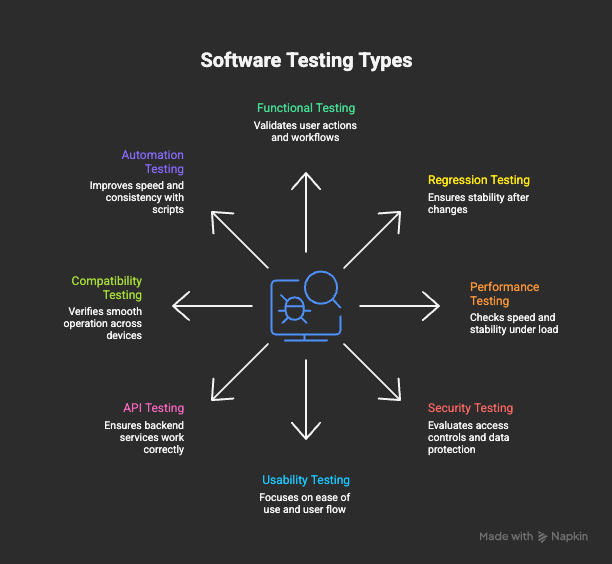
Software testing types
1. Functional testing:- Validates user actions, workflows, and business rules under normal and edge conditions.
- Teams use functional testing to confirm core journeys such as login or payments, and feature behaviour across systems.
- Verifies that existing functionality remains stable after changes.
- Agile teams use regression testing to ensure the new release doesn’t break previous features.
- Checks how fast and stable the system is under load.
- Performance testing is done before releases to ensure the system works with the expected traffic.
- Evaluates access controls, data protection, and unsafe inputs to reinforce security.
- Teams use it for apps that handle sensitive data or user accounts and also to meet compliance requirements.
- Focuses on ease of use, navigation, and overall user flow.
- Usability testing is used for consumer apps or new market launches to spot confusing steps and design issues.
- Ensures backend services work correctly together, validating data flow and system integrations.
- Teams use it when building microservices, connecting third-party tools, or supporting multiple apps on the same backend.
- Verifies the software works smoothly across different devices, browsers, and operating systems.
- Teams rely on it for web and mobile apps with users on varied devices and OS.
- Runs repeatable tests using scripts and tools to improve speed, consistency, and coverage in agile and DevOps workflows.
- Teams automate high-value flows such as regression tests to support frequent releases without added maintenance effort.
Experienced QA providers help companies apply the right testing depth at the right stage. If companies do not have sufficient resources, they can consider outsourcing the QA testing services.
Should you outsource QA testing services?
As software systems grow, internal QA teams often struggle to keep up with increasing testing demands. Limited capacity and tight release timelines can lead to coverage gaps and increased production risk. Outsourcing QA testing extends testing capability without slowing development.
To assess whether this approach fits your needs, the table below compares in-house QA teams with external QA service providers.
|
Aspect |
In-house QA teams |
QA testing service providers |
|
Skill coverage |
Limited to the skills of a small, fixed team |
Wide expertise across platforms, devices, and test types |
|
Scalability |
Hard to scale quickly for large releases |
Can scale testing up or down on demand |
|
Speed to execute |
Slows down when teams are stretched |
Dedicated teams maintain release pace |
|
Cost structure |
Fixed costs for staff, tools, and training |
Flexible costs based on testing needs |
|
Governance & reporting |
Depends on internal process maturity |
Standard processes and clear reporting |
Using a crowdtesting approach, GAT teams helped Flip reduce its regression testing cycle by 1.5 weeks per sprint. Almost half of the regression scenarios were handled externally, allowing internal teams to focus on development and customer feedback.
What makes a leading software testing company?
The wrong testing company can miss critical risks and create poor visibility into product quality. Many providers focus only on executing test cases without understanding the system or business impact.
Here is what makes a reliable testing company:
- The key difference lies in innovation and methodology. Top companies use advanced tools, frameworks, and automation to maximize coverage and efficiency. They integrate QA into CI/CD pipelines for continuous testing without slowing development.
- Technical capability sets strong companies apart. Their QA engineers understand modern architectures, APIs, cloud platforms, and CI/CD pipelines. This allows testing to align with real system behavior rather than surface-level checks.
- Expertise in real-world testing scenarios is another hallmark. Leading providers use diverse devices, network conditions, and user environments to uncover issues that internal teams might miss. Security testing, localization, and usability evaluation are all part of this broader perspective.
- Quality leadership is also shown through accountability. Top firms track metrics such as defect trends, test coverage, release stability, and system performance to continuously optimize their approach.
To select a QA partner, here are a few actionable bullets from our experts:
- Go through the company’s previous clients and case studies to ensure that they have expertise working in your industry.
- Assess how well they can integrate into your test environments, with your tracking and testing tools.
- Review how the external QA teams will be managed. Does the partner provide fully managed or semi-managed QA teams?
- Evaluate how the feedback looks will work, and how bugs will be logged and tracked. Expert QA service providers like GAT provide extensive metrics dashboards, which allow stakeholders to answer questions like ‘Are we good to release this build to customers?’
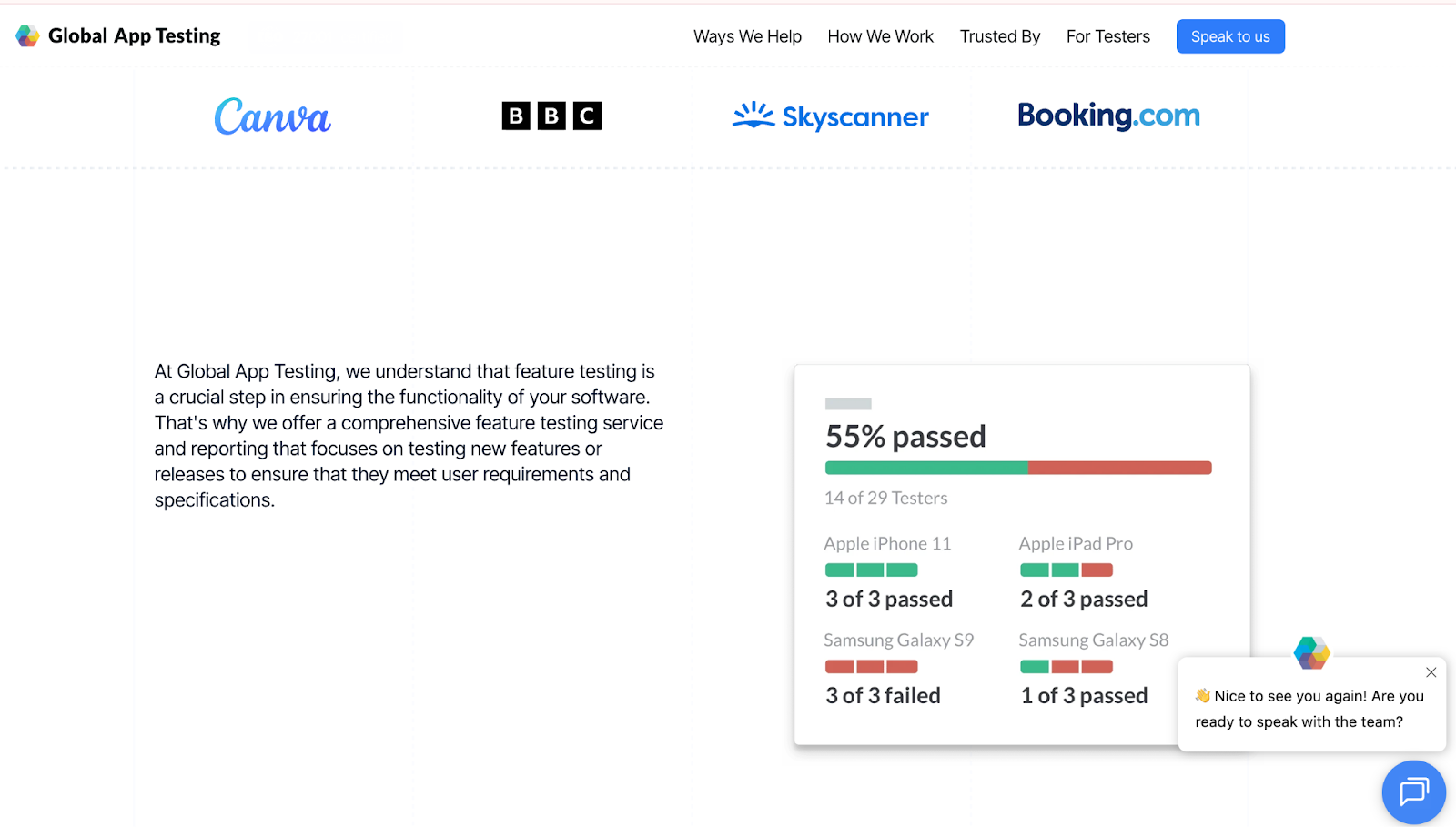
GAT Reporting Dashboard
Once the right partner is in place, the next challenge is to build a QA process that scales with product growth.
How to build a scalable QA testing process?
As products grow across devices, regions, and user types, QA teams often hit scale limits. In-house teams are usually small and lack access to diverse devices, languages, and real-world conditions. To scale testing without slowing releases, teams need a model that combines internal QA ownership with external testing capacity.
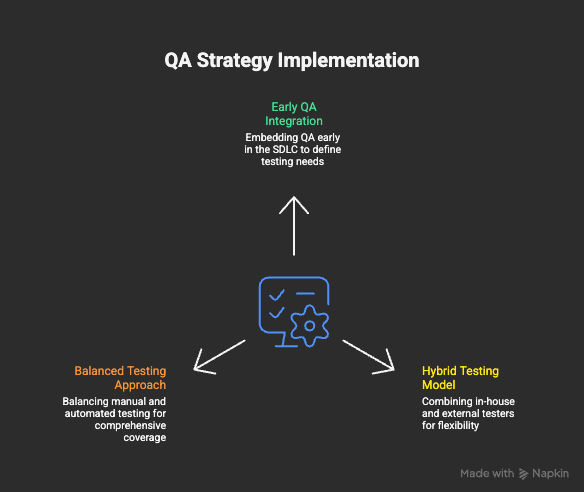
Building a scalable QA process
Here is how to build a foundation that lasts:
- Define the QA strategy early: Determine which testing types are required, define target audiences, and determine the device and OS combinations that need coverage.
- Use a hybrid testing model: In-house teams own test strategy, automation, and release decisions. External testers provide a flexible scale across devices, locations, and real-world conditions. This hybrid model supports peak testing needs without long-term cost increases.
- Balance manual and automated testing: Not all tests should be automated. Exploratory testing, usability checks, and new feature validation require human judgment and are best run manually. Automation should focus on repeatable and high-risk flows like regression, smoke tests, and APIs. This balance keeps testing fast without sacrificing insight.
- Align Dev and QA teams: Aligning QA with development ensures testing supports real product goals and integrates smoothly into delivery workflows.
A scalable QA process creates predictability and release confidence. With this foundation in place, teams can use automation to further improve speed and test coverage at scale.
What are the benefits of test automation?
As release cycles accelerate, repeating the same tests manually becomes inefficient and hard to scale. Test automation solves this by running repeat checks consistently and at speed.
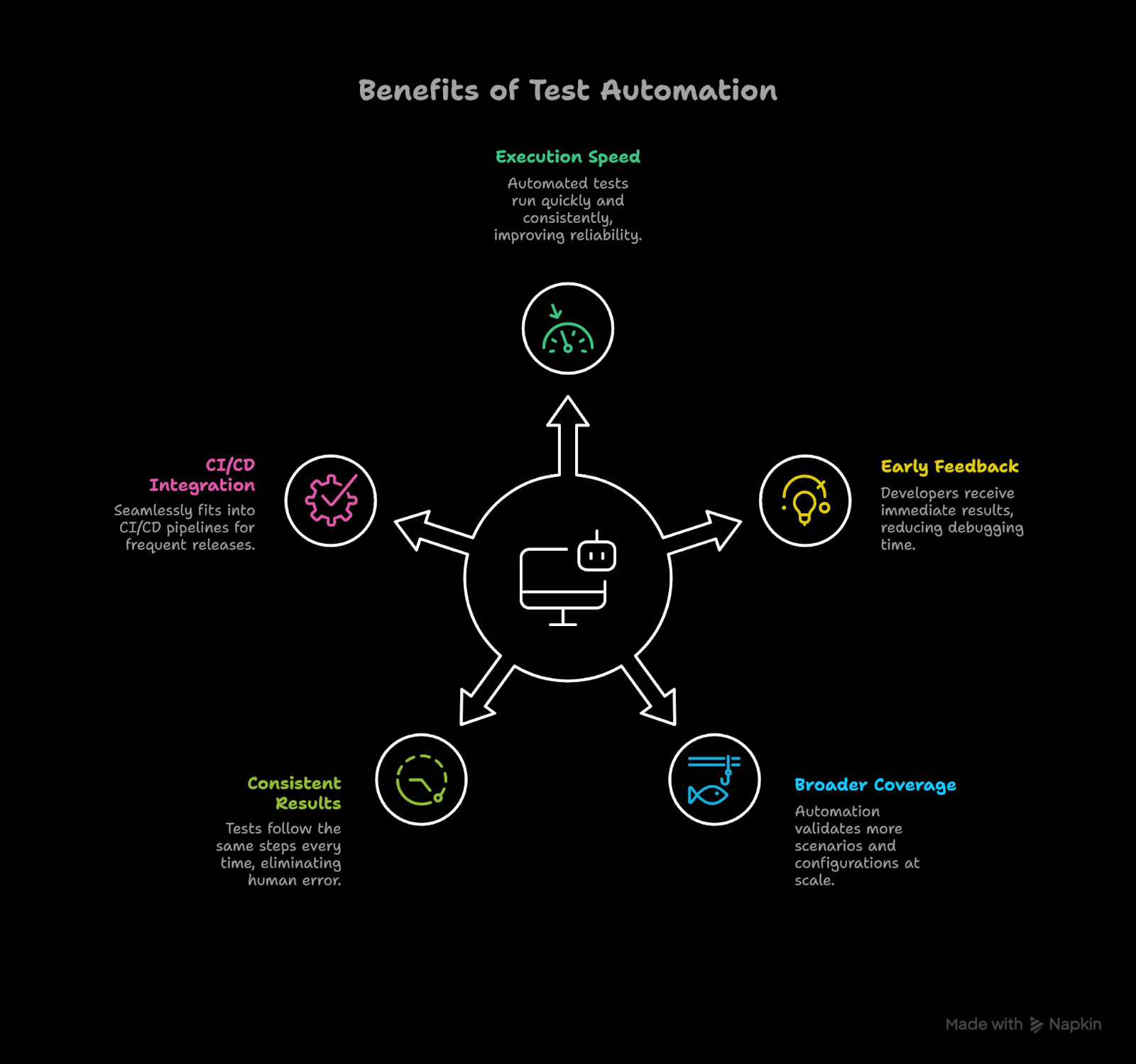
Benefits of test automation
- Improves execution speed and coverage: Automated tests run quickly and consistently across builds. This allows teams to validate more scenarios, configurations, and workflows in less time than manual testing.
- Helps capture bugs early: Automation shortens feedback cycles by detecting failures soon after code changes. This makes issues easier to fix and reduces rework later in the release process.
- Enables effective API and UI testing at scale: Automated frameworks support large-scale testing for stable integrations and smooth user flows across frequent releases and complex systems.
While automation handles repetitive and predictable tests, manual testing complements it by covering:
- Exploratory testing
- Usability testing
- Edge cases
How can GAT help in accelerating your QA efforts?
At Global App Testing (GAT), we meet these needs with a proven crowdtesting model that combines human expertise and real-world conditions. GAT provides access to a global network of over 100,000 testers across 190+ countries, ensuring coverage across devices, languages, and market-specific conditions.
Reach out to our sales team if you want to accelerate your QA efforts, scale testing globally, and ensure reliable releases.